Welcome to our company!



Ferrite Core Applications in Rail Transit and Transportation Electronics
Comprehensive overview of ferrite core requirements for rail transit applications, covering traction drives, auxiliary power supplies, trackside infrastructure, and IEC 60077/EN 50155 compliance.
2026-03-28 22:33
Ferrite Core Applications in Rail Transit and Transportation Electronics
Share
# Ferrite Core Applications in Rail Transit and Transportation Electronics The rail transit industry represents one of the most demanding environments for power electronics. Systems onboard locomotives, rolling stock, and infrastructure equipment must operate reliably across extreme temperature ranges, endure vibration and mechanical shock, meet stringent safety standards, and deliver decades of maintenance-free operation. Magnetic components — particularly ferrite cores — are central to power conversion, filtering, and isolation throughout rail systems. This article explores the specific requirements of rail transportation and how ferrite core selection must be adapted to meet them.
The Rail Transit Environment
Unlike consumer or even most industrial applications, rail electronics face a uniquely challenging combination of stressors: **Wide temperature range**: Exterior equipment on locomotives and infrastructure can see temperatures from -40°C to +85°C, depending on geographic location and installation position. Interior equipment is more benign but still ranges from -25°C to +70°C. **Vibration and mechanical shock**: Track irregularities, traction motor vibration, and couplers during shunting operations create continuous vibration and occasional high-shock events. Magnetic components must survive without mechanical degradation or connection failures. **Power quality challenges**: Railway electrification systems introduce significant noise and transients. DC traction systems can have voltage spikes of hundreds of volts; AC systems see harmonic distortion and voltage fluctuations from thyristor-controlled systems. **Safety standards**: Rail electronics must meet IEC 60077 (railway rolling stock electrical equipment), EN 50155 (electronic equipment for railway applications), and often specific operator standards. These mandate particular design practices, testing procedures, and documentation. **Long lifetime expectations**: Rail vehicles operate for 30–40 years. All components, including magnetic cores, must maintain performance throughout this extended operational life.Application Areas in Rail Systems
Traction Drive Power Electronics
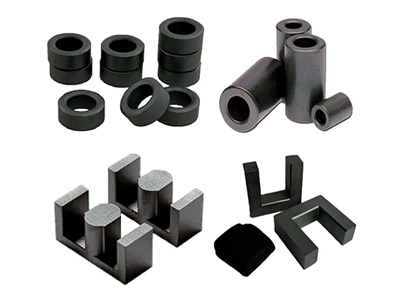
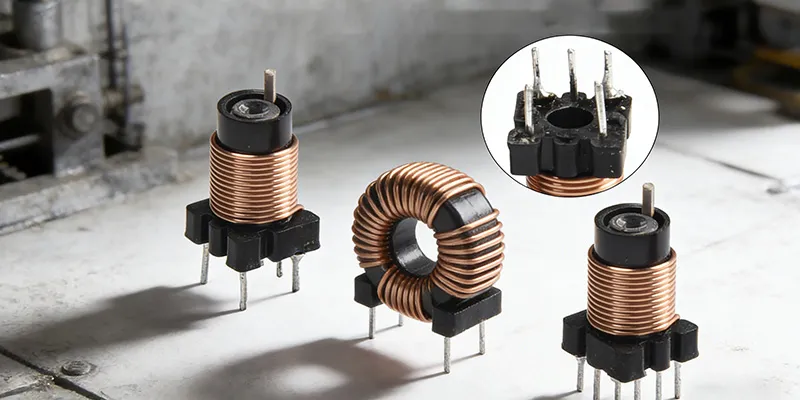
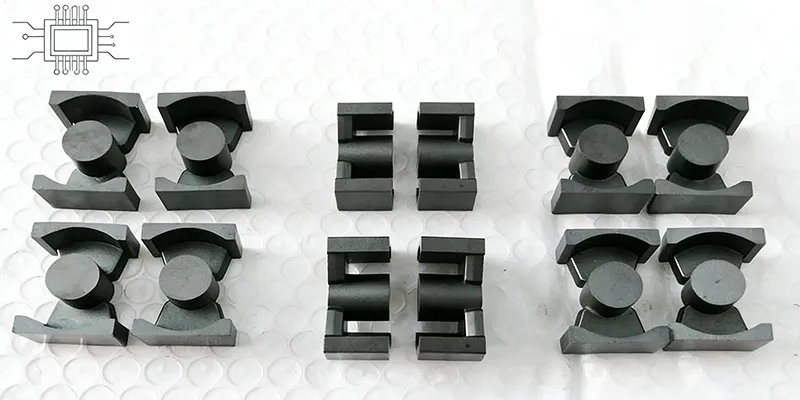
Modern electric and diesel-electric locomotives use variable-frequency drives (VFDs) to control traction motors. These converters transform the incoming supply (typically 25kV AC or 750V–3kV DC) to variable voltage, variable frequency AC for the traction motors. Key magnetic components: **DC-DC converters** in the onboard power supply system (for hotel power, battery charging, auxiliary systems) use EER or ETD cores with TOMITA 2G8 material. These typically operate at 2–10 kHz switching frequency for the main traction inverter. **Filter inductances** on the DC bus smooth current ripple and limit di/dt during switching events. These require PQ or E-core geometries with robust thermal management, as they carry continuous current at high power levels. **Isolation transformers** between the traction converter and auxiliary systems must meet IEC 60077 isolation requirements. Standard transformer geometries (EER, ETD) are used withClass H insulation systems.Auxiliary Power Supplies
Every rail vehicle needs auxiliary power for lighting, HVAC, passenger information systems, and control electronics. These are typically lower-power systems (5–50 kW) but still demanding in terms of reliability. **DC-DC converters** for 24V, 48V, and 72V auxiliary buses use ferrite cores in the same topologies as industrial power supplies but with enhanced thermal and mechanical specifications. **EMI filtering** is critical — not just for regulatory compliance but for electromagnetic compatibility with signaling systems. Incorrectly filtered switching supplies can interfere with track circuits and train control systems, creating safety risks.Trackside Power Infrastructure
Beyond the vehicle itself, magnetic components appear throughout rail infrastructure: **Wayside power supplies** convert AC utility power for track circuits and signaling. These are typically lower-power but must operate in outdoor cabinets with the full temperature range. **DC traction power substations** use large filtering inductances to smooth the rectified DC output from thyristor-controlled converters. These use air-core or ferrite-core inductors sized for hundreds of amps. **Overhead line monitoring** systems require current transformers and filtering components that operate reliably in the electromagnetic environment near high-voltage AC lines.Ferrite Core Selection for Rail Applications
Temperature Considerations
For exterior equipment, specify ferrite materials with adequate thermal margin: - Standard Mn-Zn ferrites (Tc ≈ 200–230°C) are adequate for interior applications with controlled temperature - For unconditioned exterior installations, select materials with documented performance at +85°C minimum - At high ambient temperatures, derate saturation flux density by 15–20% compared to catalog values TOMITA's 2G8 material maintains good magnetic performance across the full rail temperature range when properly derated. The 2G8A variant offers improved high-temperature stability for particularly demanding applications.Vibration and Mechanical Stress
Ferrite cores are inherently brittle ceramics, making them susceptible to cracking under sustained vibration or mechanical shock. Design practices for rail applications: **Flexible mounting**: Use silicone vibration-damping pads between the core assembly and the PCB or chassis. Avoid rigid epoxy bonds in high-vibration areas — the differential movement between ferrite and metal housing causes cracking over thermal cycles. **Epoxy coating**: For critical applications, specify epoxy-coated cores or apply conformal coating over the complete magnetic assembly. This provides mechanical constraint that reduces crack propagation even if microcracks form. **Thermal cycling derating**: If the application involves more than 10 thermal cycles per day, derate core performance by an additional 10% to account for fatigue. **Testing**: For automotive-equivalent or high-reliability rail applications, specify cores that have passed AEC-Q200 thermal shock testing. Documented test data (thermal cycling, vibration, mechanical shock) provides confidence in long-term reliability.Material Grades for Rail Applications
| Application | Recommended Material | Key Reason |
|---|---|---|
| Traction inverters, 2–10 kHz | TOMITA 2G8 | Low loss, thermal stability |
| Auxiliary DC-DC converters | TOMITA 2G8A | Enhanced high-temp performance |
| High-frequency filtering | TOMITA 6G8 | Good loss at elevated frequencies |
| EMI suppression, low frequency | TOMITA 2H5 | High permeability for max impedance |
| High-current DC chokes | TOMITA 2G8 or 2G8A | Handles DC bias with low loss |
Railway Safety Standards and Documentation
When specifying ferrite cores for rail applications, documentation requirements are typically more demanding than consumer or standard industrial applications: **IATF 16949 / ISO 9001**: Most rail equipment suppliers require components from manufacturers with documented quality management systems. TOMITA maintains ISO 9001 certification, and GRXElec can provide quality documentation for orders. **Traceability**: Rail safety standards often require traceability to production lot for critical components. GRXElec can provide lot traceability documentation for specific order batches when required. **Datasheet validation**: Ensure the ferrite material specifications (particularly Curie temperature, loss characteristics, and saturation flux density) are validated at the temperatures your application will actually see — not just at the catalog's reference temperature of 25°C or 100°C. **FMEDA support**: For functional safety applications (rail crossing controls, train protection systems), GRXElec can provide failure mode data to support FMEDA (Failure Mode, Effects, and Diagnostic Analysis) documentation requirements.Designing for 30-Year Reliability
Rail vehicles operate for decades, not years. Designing magnetic components for this lifetime requires: **Thermal margin**: Design for the maximum ambient temperature minus 20°C as your operating point. At 85°C maximum ambient, design for 65°C maximum component temperature. This provides thermal margin for unexpected thermal resistance increases (fan failure, dust accumulation) over the vehicle lifetime. **Derating practice**: Derate ferrite core saturation flux density to 70% of catalog maximum at worst-case temperature. This accounts for material batch variation and aging effects. **Thermal cycling management**: Track thermal cycling in the application. If the equipment experiences more than approximately 10 cycles per day between temperature extremes, add additional thermal cycling derating to the design. Every 10°C increase in operating temperature roughly doubles the rate of degradation mechanisms. **Connection reliability**: Solder joints and terminations are more likely to fail than the ferrite core itself in long-life applications. Specify robust termination methods (thrifty terminals, welded connections where possible) and ensure thermal expansion compatibility between the ferrite, bobbin, and PCB.Case Study: Onboard Battery Charger
A typical battery charger for rail vehicle backup batteries (24V or 48V lead-acid or lithium) illustrates the design considerations: The charger operates from the auxiliary DC bus (typically 110V or 74V nominal DC in railway systems), with an isolated DC-DC stage to charge the battery bank. The transformer in this application sees: - Input voltage range: 77V to 137V DC (full railway DC bus tolerance) - Output: 28V or 56V at up to 20A - Switching frequency: approximately 70–100 kHz - Operating temperature: -25°C to +70°C (interior, temperature-controlled) Core selection: - EER-35 or ETD-34 geometry with 2G8A material - Sized for approximately 600W output with 80% efficiency target - Thermal interface to chassis for heat dissipation - Class H insulation system for the transformer assemblyConclusion
Rail transit and transportation electronics place unique demands on magnetic components — extreme temperature range, vibration and shock, stringent safety standards, and 30+ year lifetime requirements. Success requires careful core and material selection, robust mechanical design, and thermal management that accounts for degradation mechanisms over decades of operation. For railway magnetic component support, including application engineering, documentation for safety standards compliance, and long-lead-time procurement planning, contact the GRXElec team. We have experience supporting rail equipment manufacturers with ferrite solutions across a range of power levels and applications.Shenzhen Gaorunxin Technology Co., Ltd