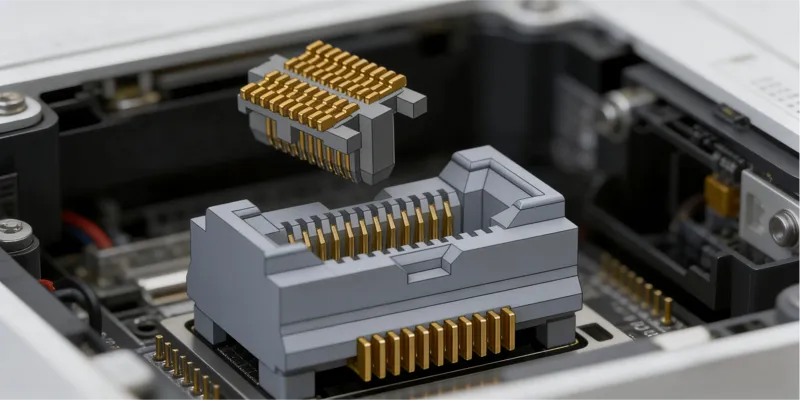


Floating Connector Applications: Industrial, Automotive, Commercial & Beyond
From factory production lines to your car, from shopping mall information displays to precision hospital equipment — floating connectors are quietly becoming an indispensable component in modern industrial electronics systems.
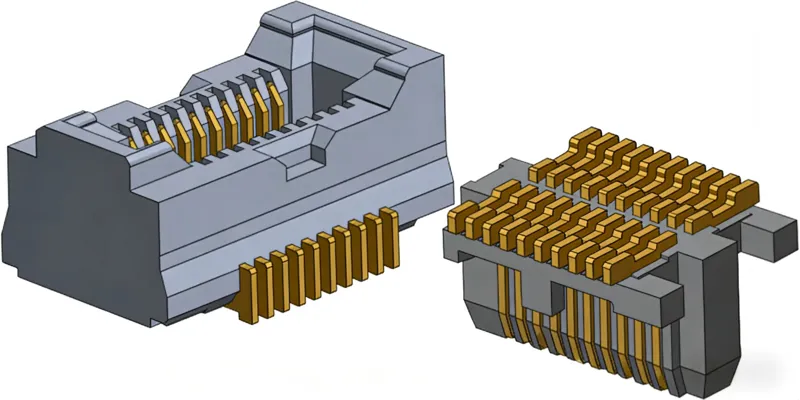
1. Industrial Applications: The Most Demanding Arena
Industrial control equipment is one of the most critical application domains for floating connectors, and also where the performance requirements are most stringent.
Typical Devices:
- Programmable Logic Controllers (PLC) — The brain of factory automation systems, required to operate reliably for years in high-temperature, vibration-heavy industrial environments
- Computer Numerical Control (CNC) machines — Generate continuous mechanical vibration during cutting operations, placing extreme demands on connector vibration resistance
- Sensor modules and control modules — Distributed throughout industrial equipment in large numbers, requiring reliable connections under complex operating conditions
Industrial environments are characterized by intense vibration, harsh conditions, and long equipment lifecycle requirements. Standard connectors in these environments often suffer from solder joint fatigue and contact wear. Floating connectors, with their elastic buffering mechanism, effectively absorb vibration stress and significantly extend the effective service life of equipment.
2. Automotive Applications: Reliable in Every Pothole
Modern vehicles are more electronic than ever. A typical passenger car contains dozens of ECUs (Electronic Control Units), and premium vehicles may have over a hundred. All of these ECUs need to exchange data and transfer power through large numbers of connectors.
Typical Devices:
- GPS systems — Require continuous, stable signal reception; high connection reliability is essential
- Infotainment systems — Board-to-board connections between displays and host units must withstand persistent vibration from driving
- Wireless communication modules — Internal PCB connections for Bluetooth, Wi-Fi, 4G/5G vehicle modules
- LED instrument clusters — Internal connections within dashboard display assemblies
Vehicles travel across all kinds of road surfaces — vibration and jolting are unavoidable physical realities. Additionally, automotive components are assembled with inherent manufacturing tolerances. The floating connector built-in tolerance accommodation naturally resolves these assembly deviations, ensuring stable electrical connections throughout the vehicle service life.
3. Commercial Equipment: The Invisible Backbone of Business Operations
Commercial electronics have equally demanding reliability requirements. These devices typically run continuously and uninterrupted — any connection failure can directly disrupt business operations.
Typical Devices:
- Indoor fine-pitch LED displays — High-definition display systems in showrooms, conference rooms, and malls contain extensive board-to-board connections between LED driver PCBs
- Information terminals — Point-of-sale systems, self-service kiosks, and similar high-frequency-use devices require long-term stable connections
Commercial equipment is frequently disassembled for maintenance. The excellent assembly compatibility of floating connectors supports direct insertion and automated assembly, making maintenance much more convenient. Their high tolerance for misalignment also reduces the risk of damage from handling errors during repair.
4. Consumer Electronics and Medical: Expanding Into New Territory
Consumer Electronics Applications:
- Washing machines, dishwashers, and other home appliances (must withstand motor-generated vibration)
- Blenders, food processors, and similar small appliances
- Internal PCB connections in various portable electronic devices
Medical Device Applications:
- Precision diagnostic and testing equipment
- Life support and monitoring devices requiring ultra-high-reliability electrical connections
In the medical field, any single connection failure can have serious consequences. The high-reliability characteristics of floating connectors take on special importance here.
5. Looking Ahead: A Growing Application Footprint
This forecast is grounded in solid technological and market fundamentals:
- Continued industrial automation upgrades — Higher levels of automation mean more, denser board-to-board interconnect requirements
- Rapid growth of EVs — Electric vehicles have more complex electronics than traditional ICE vehicles, driving surging demand for high-reliability connectors
- Constant consumer electronics iteration — Smart home devices, wearables, and other emerging categories are opening new application scenarios
- 5G and IoT deployment — Mass deployment of industrial IoT devices creates widespread demand for reliable board-level connections
Summary
| Application Sector | Typical Devices | Core Reason for Using Floating Connectors |
|---|---|---|
| Industrial | PLC, CNC, sensor modules | Resists intense vibration, ensures long-term reliability |
| Automotive | GPS, infotainment, wireless modules | Handles road vibration, tolerates assembly variance |
| Commercial | LED displays, information terminals | Easy assembly/maintenance, long-term stability |
| Consumer Electronics | Home appliances, portable devices | Handles motor vibration, reduces failure rate |
| Medical | Precision diagnostic equipment | Meets ultra-high reliability requirements |
Conclusion
From factory floors to living rooms, from city streets to the operating table, floating connectors are supporting the stable operation of the modern electronics world in a quiet but essential way. They are not a niche product confined to a single vertical market — they are a general-purpose solution expanding into an ever-wider range of application scenarios.
Shenzhen Gaorunxin Technology Co., Ltd