Welcome to our company!



MEMS vs Quartz Oscillators: Which to Choose for IoT and Edge Devices
Both MEMS and quartz oscillators provide accurate timing — but they suit very different applications. This comparison breaks down stability, power consumption, size, cost, and reliability to help you choose between MEMS and quartz in IoT, wearable, and edge AI designs.
2026-07-15 14:16
MEMS vs Quartz Oscillators: Which to Choose for IoT and Edge Devices
Share
# MEMS vs Quartz Oscillators: Which to Choose for IoT and Edge Devices Every embedded system needs a clock. For decades, that meant a quartz crystal — period. Then silicon MEMS oscillators came along, and the calculus changed. MEMS didn't kill quartz, but they carved out a substantial slice of the timing market where quartz used to be uncontested. The question — quartz or MEMS — has no universal answer. It depends on your system voltage, power budget, board layout, environmental requirements, and lifecycle expectations. This article walks through the trade-offs so you can pick the right technology for your specific design without bias.
At standard commercial and industrial grades, plain quartz and MEMS perform similarly. Where MEMS pull ahead is when you need TCXO-class stability without designing a discrete TCXO circuit — the MEMS TCXO has the temperature compensation already integrated.
What's Different — How They Work
**Quartz oscillators** use a precisely cut piece of quartz crystal that vibrates at a specific frequency when excited by an electric field. The piezoelectric effect converts mechanical vibration back to electrical signal, sustaining oscillation. Quartz has been refined for over a century — the manufacturing processes, aging characteristics, and failure modes are deeply understood. **MEMS oscillators** use a silicon microstructure (typically a tiny cantilever or resonator) that vibrates at MHz frequencies. The resonator is manufactured on a CMOS-compatible process, then packaged with a PLL and output driver on the same die or in the same package. The MEMS element itself produces a relatively low-Q output, but the integrated PLL synthesizes a clean, programmable output frequency. The architectural difference matters: a quartz oscillator's accuracy is set by physics (the cut and shape of the crystal), while a MEMS oscillator's accuracy is set by its PLL and the temperature-compensation circuitry.Frequency Stability Across Temperature
This is where the technologies differ most clearly:| Specification | Standard Quartz (HC-49, SMD) | Industrial / Automotive Quartz | TCXO (Temperature-Compensated Quartz) | MEMS Oscillator (TCXO-class) |
|---|---|---|---|---|
| Total frequency error over -40 to +85°C | ±30 to ±50 ppm | ±10 to ±30 ppm | ±0.5 to ±2.5 ppm | ±0.5 to ±2.5 ppm |
| Total frequency error over -40 to +125°C | Not specified | ±20 to ±50 ppm | ±2.5 to ±5 ppm | ±2.5 to ±5 ppm |
| Aging (10 years) | ±5 to ±10 ppm | ±5 to ±10 ppm | ±1 to ±3 ppm | ±1 ppm |
Power Consumption
This is where MEMS typically win decisively: - **Quartz crystal:** Consumes essentially no power itself — the oscillator circuit on the MCU draws tens of microamps to drive it. Power draw is on the order of 100 µA to 1 mA for the active oscillator circuit. - **MEMS TCXO:** Integrated PLL and temperature compensation circuitry, but the part is highly optimized. Standalone MEMS TCXOs consume roughly 1 mA to 5 mA active. Where quartz wins in low-power designs: - The crystal itself draws zero current; only the MCU oscillator circuit consumes power - An MCU's low-power modes (RTC running from 32.768 kHz crystal) consume ~1 µA total - MEMS parts often have higher standby current than an MCU's RTC mode For battery-powered IoT devices that spend most of their life in sleep mode, an MCU + 32.768 kHz quartz crystal typically consumes less power than a MEMS part.Size and Integration
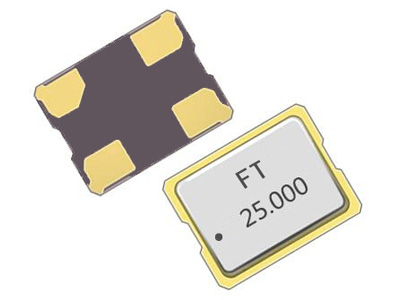
MEMS oscillators are more compact for the same functionality, because the resonator, compensation circuitry, and output driver fit in one package: - Standard 3225 SMD oscillator (MEMS TCXO) integrates everything - A comparable TCXO using quartz requires the resonator plus external compensation IC or chip-scale hybrid - For simple non-compensated oscillators, quartz is often smaller and cheaper If your design needs temperature-compensated timing in a tight space, MEMS TCXO is more compact. If you only need basic timing, quartz in 3225 or 2520 is hard to beat.Vibration and Mechanical Shock
Quartz is brittle. The crystal element is a precisely shaped piece of quartz, and high G-forces or resonance at the wrong frequency can crack it or shift its calibration. Automotive designs with high vibration need careful mounting and often external shock mounting. MEMS oscillators are silicon-based and significantly more rugged. SiTime (the dominant MEMS oscillator vendor) and similar suppliers publish vibration and shock specs that often exceed automotive requirements by 10× or more. For: - Industrial machinery with high vibration - Automotive under-hood applications - Aerospace and defense - Handheld devices subjected to drops - Motor control boards near PWM switching MEMS is the safer choice mechanically.EMI and Phase Noise
Quartz oscillators generally produce cleaner phase noise profiles, especially in the close-in range (1 Hz to 1 kHz offset). For applications where phase noise matters — radio front-ends, high-speed data converters, test equipment — quartz TCXOs and OCXOs still outperform MEMS. Modern MEMS TCXOs have closed the gap significantly for general-purpose RF, but for the most demanding phase noise specs (cellular base stations, high-end instrumentation), quartz OCXO or VCXO still wins.Supply Voltage and Flexibility
MEMS oscillators are programmable at the factory for any frequency from 1 MHz to 700 MHz, with arbitrary output formats (CMOS, LVPECL, LVDS, HCSL). One part number can replace many. This makes the supply chain simpler — fewer part numbers to stock. Quartz oscillators are fixed at one frequency. Need a different frequency? Different part number. Different output format (differential vs single-ended)? Different part number. If you manufacture multiple SKUs with varying clock frequencies, MEMS can reduce inventory.Cost — Where Each Wins
At standard commercial-grade specifications: - **Quartz wins** at low frequencies (32.768 kHz tuning forks especially) and basic MHz crystals in 3225 or larger - **MEMS wins** at high frequencies (above ~100 MHz), TCXO functionality, and in tight packages A rough 1000-piece pricing comparison: - Standard 24 MHz quartz 3225, 12 pF, ±20 ppm: $0.20 - $0.50 - MEMS TCXO equivalent: $1.50 - $3.00 - Quartz OCXO (high stability): $20 - $50+ - MEMS OCXO equivalent: $15 - $30 For designs that don't need TCXO stability, quartz is significantly cheaper.Application-by-Application Recommendations
**Choose quartz when:** - You're building a low-cost consumer device (MCU clock, USB-UART bridge) - You need a 32.768 kHz RTC with very low standby current - The design must operate from a 3.3V or 5V supply with minimal active components - You're designing high-precision test equipment, atomic clock references, or GPS-disciplined oscillators - Budget is constrained and TCXO-level stability isn't required **Choose MEMS when:** - You need TCXO-grade stability without discrete TCXO circuit design - The product will see vibration, shock, or mechanical stress (automotive, industrial, aerospace) - You need a flexible, programmable frequency platform for multiple SKUs - Board space is tight and you want oscillator + compensation in one package - You're building ruggedized portable devices or outdoor IoT nodesHybrid Approaches That Work
A common pattern: - 32.768 kHz quartz crystal for low-power RTC and timekeeping (where quartz dominates) - MEMS TCXO for high-frequency reference and radio base (where MEMS dominates) This gives you the lowest standby power and the highest RF stability simultaneously. Many industrial IoT gateways and cellular modules use this combination.How GRX ELEC Helps
Whether you go with quartz or MEMS, GRX ELEC carries KDS's full line of quartz crystal oscillators — from 32.768 kHz tuning forks to high-frequency fundamental-mode parts up to 200 MHz — across consumer, industrial, and automotive grades. Our application engineers can help you match the right technology to your operating environment, power budget, and lifecycle expectations. For MEMS solutions, we can also recommend programmable SiTime-class oscillators with comparable specs and supply continuity. Explore the [KDS crystal catalog on GRX](https://grxelec.com/product-category/crystal-device/) or [contact us](https://grxelec.com/contact-us/) for design consultation.Shenzhen Gaorunxin Technology Co., Ltd