1 A 250 Vac Two-Element Time-Delay Glass Fuse - Eaton MDQ-1
- Product Details
- Download
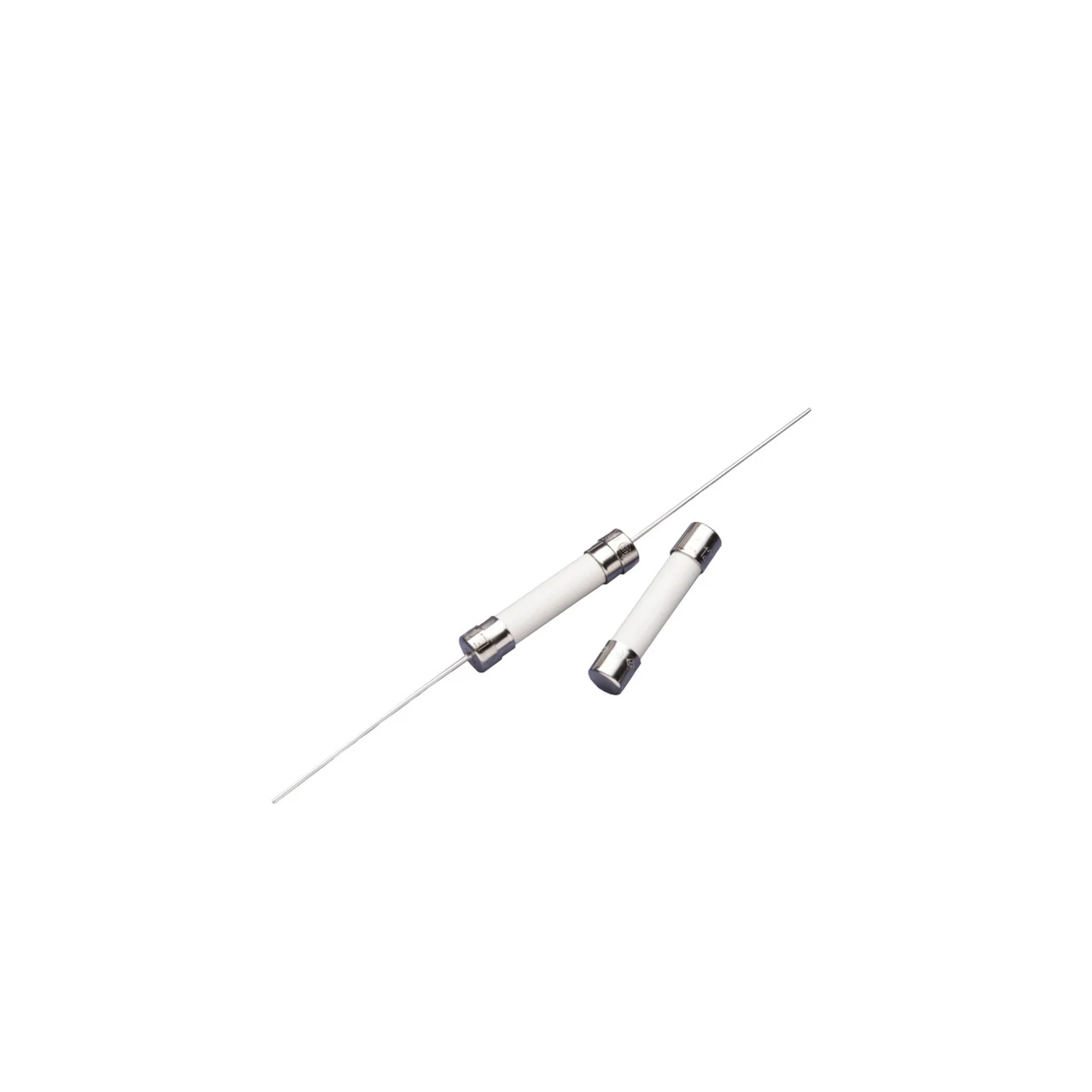
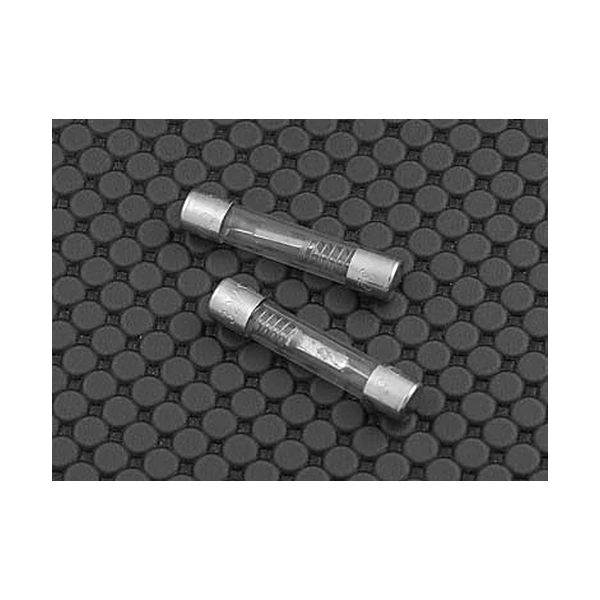
Eaton MDQ-1 1 A 250 Vac Dual-element time-delay Glass Tube Fuse
Electrical Specifications
| Part number | MDQ-1 |
| AC interrupting rating | 35 A at 250 Vac |
| Voltage rating | 250 Vac |
| Design standard | UL 248-14 |
| Breaking capacity | 35 A at 250 Vac up to 1 A, 100 A to 7 A, 1,000 A at 32 V above |
| Typical DC cold resistance | 0.374 Ω |
| End caps | nickel-plated brass |
| Element | dual element |
| Rated current | 1 A |
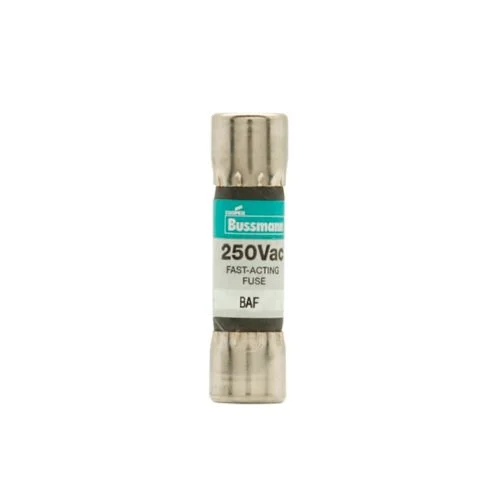
| Body | Glass tube, 1/4 x 1-1/4 in (6.3 x 32 mm) |
What the Code Tells You
MDQ is the family and 1 is the ampere rating, 1 A. The trailing -R marks the RoHS version; a packaging prefix such as BK- or BK1- may be added in front, which alters the quantity per box only.
This is the dual-element branch of the family, so the code does not carry a separate suffix for it - the family letter already implies it.
The Element and the Curve
Because the two elements are in series, the fuse still has a single curve - but the curve has a pronounced knee. Below the knee the part is effectively indestructible; above it the opening is fast. Reading only the ampere rating misses the whole point of the construction.
Reading the Numbers
The numbers in the table describe one operating point. The typical cold resistance is 0.374 Ω, which is what the circuit sees before the element warms. Everything else on the page is context for them.
Position in the Range
At one amp the part dissipates well under a watt, so thermal drift in a normal enclosure is small. That changes above five amps, where the fuse starts to be a heat source in its own right.
The step below is MDQ-3/4 at 750 mA, the step above is MDQ-1-1/4 at 1.25 A. Between the three the body, the end caps and the breaking capacity are identical; only the element changes, so the choice is the load current and nothing else.
Agency Information
UL Listed 1/16-7 A (Guide JDYX, File E19180); UL Recognition 7.5-15 A (JDYX2); CSA (1422-01).
Where the equipment ships into several markets, check each approval separately - the European and North American marks on this family do not always cover the same current range, and the gap is usually at the top of the range.
UL Listed 1/16-7 A (Guide JDYX, File E19180); UL Recognition 7.5-15 A (JDYX2); CSA (1422-01).
For a submittal pack, match the certificate to the rating on the order line. Eaton publishes the recognised range alongside each standard, and the boundary between Listed and Recognised often falls inside the family rather than at its end.
Fitting and Replacement Notes
MDQ is a genuine dual-element fuse: one element for the surge, a second for the fault. That is different from a single-element time-delay fuse with a slower curve, and it is why MDQ holds a motor start that would take out an MDL.
Fitting a 1 A part where the previous one was a different rating is the error to avoid. The fuse is there to protect the cable and the load behind it, so the rating follows from the circuit, not from what happens to be in the stores.
Questions We Get Asked
How tight should the holder clip be?
Tight enough that the fuse cannot be shaken out, loose enough that it can be pulled by hand. A clip that has lost its spring is a heat source, and the fuse gets blamed for it.
Why does the table list several breaking capacities?
Because the fuse is asked to interrupt different currents at different voltages. The 250 Vac figure is usually the smallest and the 32 V figure the largest, since a low voltage is much easier to break than a high one.
What is the difference between the voltage ratings in the table?
The fuse has a different breaking capacity at each voltage. The higher the voltage across an opening fuse, the harder the arc is to extinguish, so the current it can safely interrupt falls as the voltage rises.
Design note: the ratings above are Technical Data 2044. Verify the exact rating, the voltage at which the breaking capacity applies, and the certificate for this current before release.
Shenzhen Gaorunxin Technology Co., Ltd
Online message
Shenzhen Gaorunxin Technology Co., Ltd