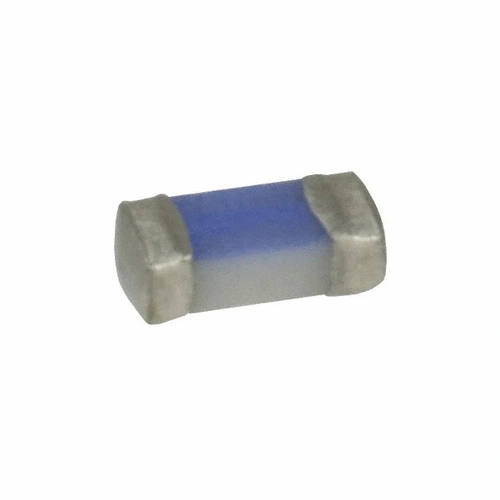


1025FA7-R Eaton 7 A Quick-Blow Ceramic Fuse 250 Vac
- Product Details
- Download
1025FA7-R Eaton 7 A Quick-Blow Ceramic Fuse 250 Vac
Ordering code TR2/1025FA7-R is the number that ships: 2,500 pieces on 24 mm tape-and-reel, one 13 inch (330 mm) reel.
Key Parameters
| Part number | 1025FA7-R |
| Ordering code | TR2/1025FA7-R |
| Packaging | 2,500 pcs on 24 mm tape-and-reel, 13 in (330 mm) reel, EIA-481 |
| Agency approval | UL Recognition, Guide JDYX2, File E19180 (250 mA - 15 A); CSA component acceptance |
| Typical melting I2t | 138 A²s |
| Voltage rating | 250 Vac |
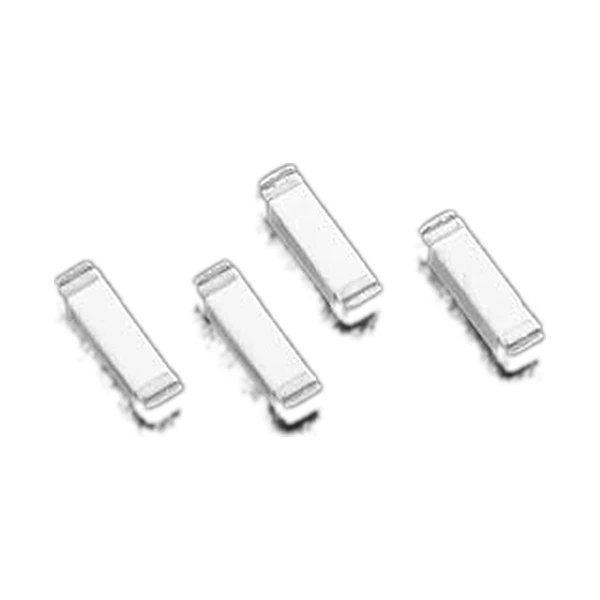
| Package | 10.29 x 2.77 mm (4010 imperial / 1025 metric) |
| Terminations | silver-plated end terminations, solder immersion compatible |
| Typical cold resistance | 0.0116 Ω |
| Rated current | 7 A |
| Voltage rating, DC | 60 Vdc |
| Design standard | EIA/IS-722 |
| Interrupting rating | 50 A AC |
| Typical voltage drop | 150 mV |
Behaviour Under Load
The element in a chip fuse is a thin film deposited on a ceramic substrate, which is why the I2t can be an order of magnitude lower than a glass tube of the same rating. Low I2t is the whole point - it is what keeps a fault from reaching the semiconductor behind it.
Decoding the Order Code
1025FA is the family, 7 is the current rating - 7 A, written without a decimal point - and -R is the RoHS suffix.
A packaging prefix such as TR2- goes in front of the whole code and changes only the reel quantity.
The Secondary Columns
Read the row from the right. The cold resistance is 0.0116 Ω, which is what the circuit sees before the element warms. Melting takes 138 A²s, so a fault has to deliver that much energy before the element even starts to go. At rated current the drop is 150 mV. The ratings on the left only say when those figures apply.
This Rating in Context
At this rating the element is carrying real current and the cold resistance is in the tens of milliohms. The fuse no longer affects the circuit in normal operation, but the energy it has to clear on a fault is larger - which is where the interrupting rating starts to matter.
The step below is 1025FA5-R at 5 A, the step above is 1025FA10-R at 10 A. The package and the land pattern are identical across the three; only the element changes.
Before You Order
The 1025 body is 10.29 x 2.77 mm - noticeably longer than a 1206. On a dense board that extra length is what forces a layout change, so check the land pattern before specifying it as a substitute for a smaller part.
Because the part is not serviceable in the field, the choice is effectively made once. Confirm what the branch actually draws, including the inrush, before the first build - not after the first failure.
Approvals
UL Recognition, Guide JDYX2, File E19180 (250 mA - 15 A); CSA component acceptance.
The approval covers a current range rather than the whole family, so a certificate that lists one rating does not automatically cover the next. For a submittal, quote the file number against the exact rating on the order line.
UL Recognition, Guide JDYX2, File E19180 (250 mA - 15 A); CSA component acceptance.
The data sheet states the range each approval covers. Where a part is being used outside that range - typically at the top of the current scale - the file number no longer applies even though the part number does.
FAQ
Are these parts AEC-Q200 qualified?
Only where the data sheet says so. The qualification is listed per family and sometimes per current range; a part number in the same series is not automatically covered.
How is the part marked?
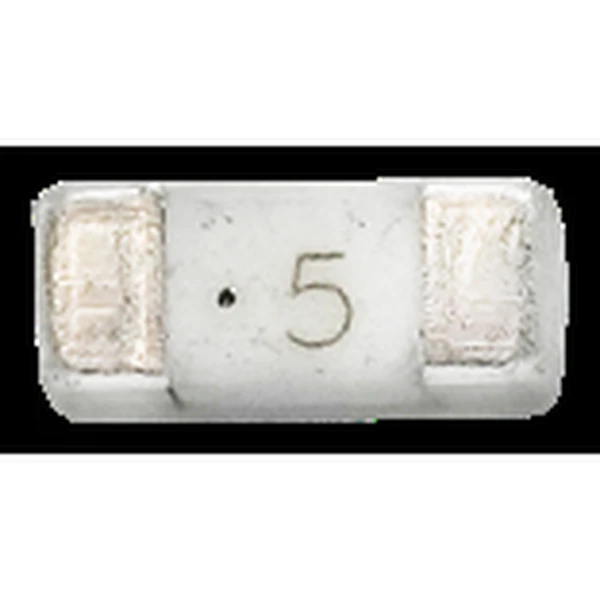
With a short code that identifies the rating, not the full part number. On a small body that code is a single letter or digit, which is why a mismatched reel is hard to spot once the parts are out of their packaging.
What is the difference between the AC and DC ratings?
A DC arc does not self-extinguish at a current zero, so the DC rating is usually lower in voltage and in interrupting capacity than the AC one. Read both columns before assuming the part covers the application.
Design note: the figures above are Technical Data 4322, measured at 25 °C on the reference land pattern. Check the rating against the actual copper area and the ambient inside the enclosure before release.
Mechanical Dimensions

Dimensional drawing and recommended PCB pad layout from the Eaton data sheet. Tolerances and pad dimensions are as printed on the drawing; check the outline against your layout before release.
Shenzhen Gaorunxin Technology Co., Ltd
Online message
Shenzhen Gaorunxin Technology Co., Ltd