

400 mA 250 Vac Medium Time-Lag Glass Fuse - Eaton GMC-400-R
- Product Details
- Download
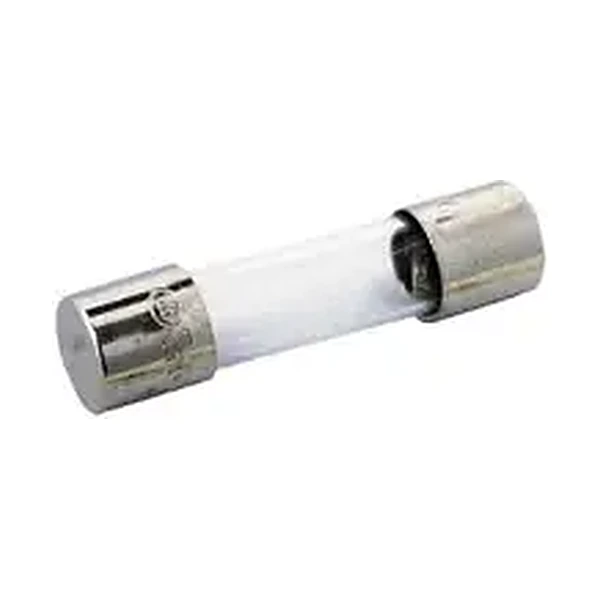
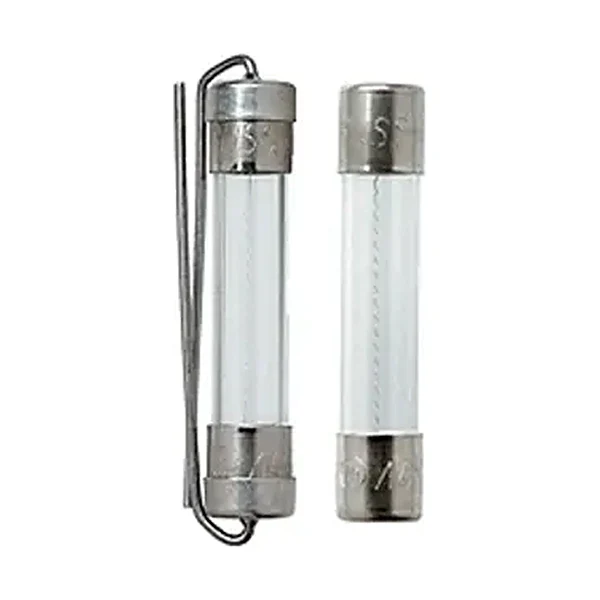
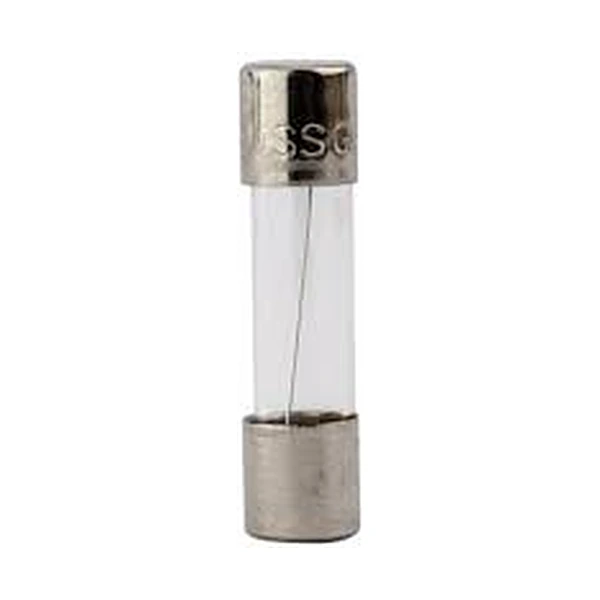
Eaton GMC-400-R 400 mA 250 Vac Medium time-delay Glass Tube Fuse
Specifications
| Part number | GMC-400-R |
| Body | Glass tube, 5 x 20 mm |
| Rated current | 400 mA |
| Voltage rating | 250 Vac |
| Design standard | UL/CSA 248-14 |
| End caps | nickel-plated brass |
| Typical DC cold resistance | 0.615 Ω |
| Typical melting I2t | 0.18 A²s |
| Element | single element |
| Maximum voltage drop | 510 mV |
| AC interrupting rating | 35 A at 250 Vac; 10,000 A at 125 Vac |
What the Figures Mean
The typical cold resistance is 0.615 Ω, which is what the circuit sees before the element warms. Melting takes 0.18 A²s, so a fault has to deliver that much energy before the element even starts to go. At rated current the drop across it is 510 mV. Those are the figures that decide whether this part fits a circuit, and none of them appears on the label.
How This Fuse Behaves
In a panel full of motor starters, the delay fuse is what stops the maintenance team from uprating fuses to stop them blowing. The rating stays at the conductor size and the curve absorbs the start.
Reading the Part Number
The code breaks into three parts. GMC is the family, 400 is the ampere rating written in milliamps - which is 400 mA, not 400 amps - and -R is the RoHS suffix. Reading the middle group as amps is the single most common ordering error on this series.
Where This Rating Sits
At one amp the part dissipates well under a watt, so thermal drift in a normal enclosure is small. That changes above five amps, where the fuse starts to be a heat source in its own right.
The step below is GMC-315-R at 315 mA, the step above is GMC-500-R at 500 mA. Between the three the body, the end caps and the breaking capacity are identical; only the element changes, so the choice is the load current and nothing else.
Standards and Approvals
UL Listed 63 mA-6.3 A (Guide JDYX, File E19180); UL Recognized 7-10 A (JDYX2); CSA; VDE; SEMKO; PSE.
Where the equipment ships into several markets, check each approval separately - the European and North American marks on this family do not always cover the same current range, and the gap is usually at the top of the range.
UL Listed 63 mA-6.3 A (Guide JDYX, File E19180); UL Recognized 7-10 A (JDYX2); CSA; VDE; SEMKO; PSE.
For a submittal pack, match the certificate to the rating on the order line. Eaton publishes the recognised range alongside each standard, and the boundary between Listed and Recognised often falls inside the family rather than at its end.
Selecting and Replacing
Medium time-delay sits between fast-acting and time-delay on purpose. It rides a modest surge and still opens quickly on a hard fault, which is why it is common in small adapters. It is not a substitute for GMD where the surge is a genuine motor start.
Fitting a 400 mA part where the previous one was a different rating is the error to avoid. The fuse is there to protect the cable and the load behind it, so the rating follows from the circuit, not from what happens to be in the stores.
Common Questions
Can these be soldered directly to a board?
Only the axial-lead versions, and only with a heat sink on the lead. The body is glass or ceramic and will crack if the lead is heated enough to run solder into the cap. Use a holder where one is available.
Is the melting I2t the same as the clearing I2t?
No. The figure in the table is the melting integral - the energy to start the element melting. The clearing integral also includes the arc and is larger. Size downstream parts against clearing, not melting.
What does the -R suffix mean?
It is the RoHS designation. The part is lead-free and compliant with the directive. Electrically it is identical to the non-R version, which is why both codes appear in older drawings.
Design note: the ratings above are Technical Data 4395. Verify the exact rating, the voltage at which the breaking capacity applies, and the certificate for this current before release.
Mechanical Dimensions

Dimensional drawing and recommended PCB pad layout from the Eaton data sheet. Tolerances and pad dimensions are as printed on the drawing; check the outline against your layout before release.
Shenzhen Gaorunxin Technology Co., Ltd
Online message
Shenzhen Gaorunxin Technology Co., Ltd