

6 A 250 Vac Slow-Blow Ceramic Fuse - Eaton MDA-6-R
- Product Details
- Download
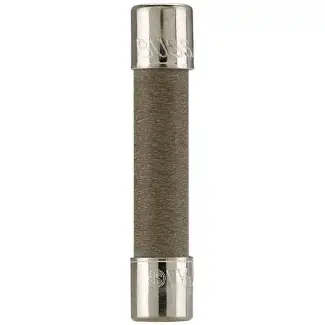
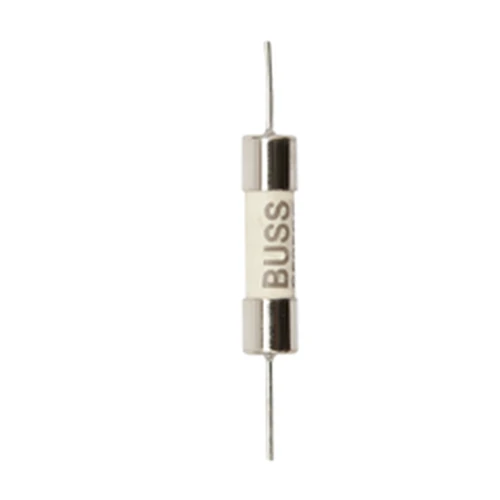
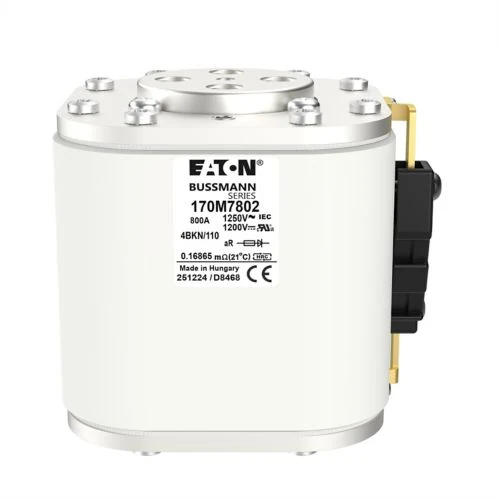
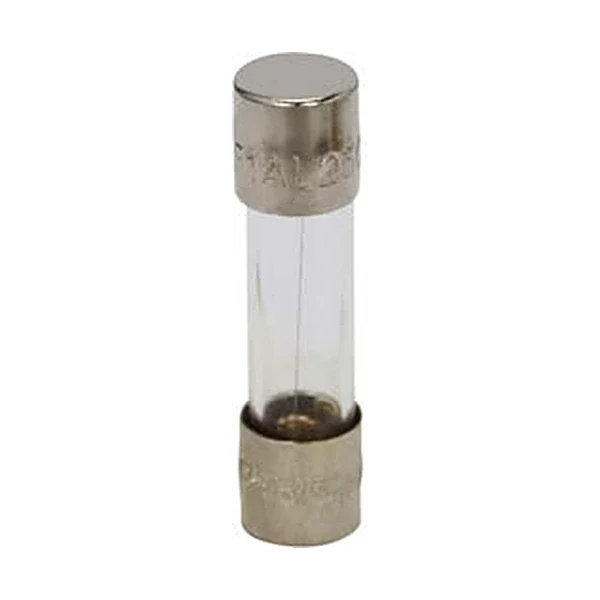
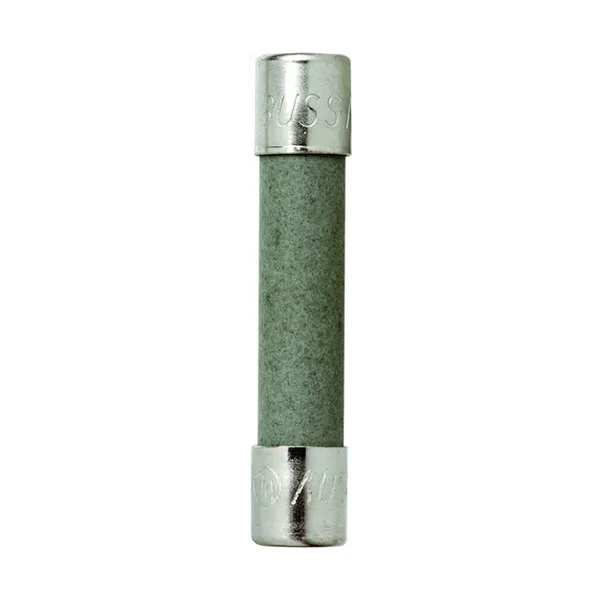
Eaton MDA-6-R 6 A 250 Vac Time-delay Ceramic Tube Fuse
Key Parameters
| Part number | MDA-6-R |
| End caps | nickel-plated brass |
| Body | Ceramic tube, 1/4 x 1-1/4 in (6.3 x 32 mm) |
| Design standard | UL 248-14 |
| Rated current | 6 A |
| Typical DC cold resistance | 18 mΩ |
| AC interrupting rating | 200 A at 250 Vac; 10,000 A at 125 Vac |
| Element | single element |
| Voltage rating | 250 Vac |
| Typical melting I2t | 98.1 A²s |
| Maximum voltage drop | 166 mV |
| Voltage rating, DC | 125 Vdc |
Decoding the Order Code
MDA is the family and 6 is the ampere rating, 6 A. The trailing -R marks the RoHS version; a packaging prefix such as BK- or BK1- may be added in front, which alters the quantity per box only.
What the Curve Does
A time-delay fuse carries a thermal mass that has to be heated before the element opens. A brief surge raises the element temperature without reaching the melting point, so a motor start passes and a sustained overload does not. The delay is a property of the construction, not a setting.
This Rating in Context
High-current tube fuses are usually protecting a distribution point rather than a single load, so the rating is set by the cable downstream. Changing the load without re-checking the cable is how a fuse ends up oversized.
The step below is MDA-5-R at 5 A, the step above is MDA-7-R at 7 A. Between the three the body, the end caps and the breaking capacity are identical; only the element changes, so the choice is the load current and nothing else.
The Three Figures That Matter
The typical cold resistance is 18 mΩ, which is what the circuit sees before the element warms. Melting takes 98.1 A²s, so a fault has to deliver that much energy before the element even starts to go. At rated current the drop across it is 166 mV. Those are the figures that decide whether this part fits a circuit, and none of them appears on the label.
Approvals
cULus Listed 1/4-20 A (JDYX & JDYX7, File E19180); cULus Recognized 25-30 A (JDYX2 & JDYX8).
For a submittal pack, match the certificate to the rating on the order line. Eaton publishes the recognised range alongside each standard, and the boundary between Listed and Recognised often falls inside the family rather than at its end.
Before You Order
MDA and ABC share the ceramic 1/4 x 1-1/4 in body; the difference is the element. MDA is time-delay, ABC is fast-acting. Both are 3AB footprint, so again the body size tells you nothing about which one is fitted.
For a like-for-like replacement, match three things: 6 A, time-delay speed, and a voltage rating at least as high as the circuit can apply. Everything else about the part - the cap plating, the marking, the packaging prefix - is a purchasing detail rather than an electrical one.
FAQ
Is the melting I2t the same as the clearing I2t?
No. The figure in the table is the melting integral - the energy to start the element melting. The clearing integral also includes the arc and is larger. Size downstream parts against clearing, not melting.
Is the ampere rating a continuous rating?
It is the current the fuse will carry indefinitely at 25 °C without opening. In a hot enclosure the usable current is lower, which is why fuses are normally derated to about 75 % of the rating in a sealed box.
Why is the cold resistance higher on the small ratings?
The element is thinner and longer relative to its cross-section, so resistance rises as the rating falls. That is also why the smallest ratings dissipate proportionally more and are the ones most affected by a hot enclosure.
Design note: the ratings above are Technical Data 2002. Verify the exact rating, the voltage at which the breaking capacity applies, and the certificate for this current before release.
Shenzhen Gaorunxin Technology Co., Ltd
Online message
Shenzhen Gaorunxin Technology Co., Ltd