CS60N06AQ3 CR Micro 60V 60A N-Channel MOSFET PDFN5×6
- Product Details
- Download
- 60 V / 60 A continuous drain current, PDFN5×6 package
- Rds(on) 7 mΩ typ, 10 mΩ max at VGS = 10 V
- Qg 88.8 nC and Ciss 4398 pF
- N-channel, Trench process
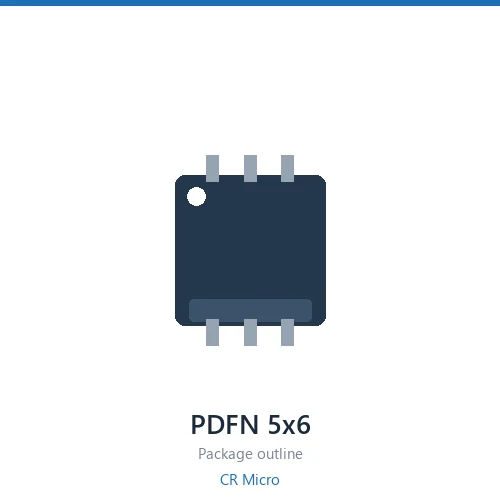
The CR Micro CS60N06AQ3 is a 60 V 60 A N-channel MOSFET in a PDFN5×6 package, built on the Trench process. On-resistance is 7 mΩ typical and 10 mΩ maximum at a 10 V gate drive; 8.5 mΩ typical at 4.5 V, so it also works from a logic-level driver; gate charge is 88.8 nC with 4398 pF input capacitance; threshold voltage spans 1 to 2 V.
Key Specifications
| Drain-Source Voltage (VDS) | 60 V |
| Continuous Drain Current (ID) | 60 A |
| Rds(on) @ VGS = 10 V, typ. | 7 mΩ |
| Rds(on) @ VGS = 10 V, max. | 10 mΩ |
| Rds(on) @ VGS = 4.5 V, typ. | 8.5 mΩ |
| Rds(on) @ VGS = 4.5 V, max. | 12 mΩ |
| Gate Threshold Voltage (VGS(th)) | 1 – 2 V |
| Total Gate Charge (Qg) | 88.8 nC |
| Input Capacitance (Ciss) | 4398 pF |
| Channel Polarity | N-channel |
| Process Family | Trench |
| Package | PDFN5×6 |
Same-Rating Selection Table
| Part Number | VDS | ID | Rds(on) typ | Rds(on) max | Qg | Ciss | Package |
|---|---|---|---|---|---|---|---|
| CRSM013N06N4Z | 60V | 260A | 1.1 | 1.39 | 102.6 | 7291 | PDFN5×6 |
| CRSM019N06N4Z | 60V | 80A | 1.55 | 1.98 | 104.8 | 7124 | PDFN5×6 |
| CRSM028N06N4Z | 60V | 80A | 2.3 | 2.8 | 60.4 | 3971 | PDFN5×6 |
| CRSM024N06L2 | 60V | 80A | 2.4 | 2.9 | 74 | 4610 | PDFN5×6 |
| CRSM024N06L2Z | 60V | 80A | 2.4 | 2.9 | 74 | 4610 | PDFN5×6 |
| CRSM034N06N4Z | 60V | 80A | 2.6 | 3.4 | 47.6 | 3031 | PDFN5×6 |
| CRSM034N06L2 | 60V | 80A | 2.8 | 3.4 | 54 | 3224 | PDFN5×6 |
| CRSM034N06L2Z | 60V | 80A | 2.8 | 3.4 | 54 | 3734 | PDFN5×6 |
| CRSM060N06L2 | 60V | 60A | 5.3 | 6.4 | 28 | 1666 | PDFN5×6 |
| CS60N06AQ3 | 60V | 60A | 7 | 10 | 88.8 | 4398 | PDFN5×6 |
| HGQ09N06A | 60V | 50A | 7.9 | 9.8 | 18 | 1226 | PDFN5×6 |
| CRTM105N06L | 60V | 56A | 8 | 10.5 | 46 | 1902 | PDFN5×6 |
| CRSM120N06L2Q | 60V | 40A | 10 | 13 | 16 | 960 | PDFN5×6 |
| CS55N06AQ3-G | 60V | 55A | 11 | 14 | 50.7 | 2370 | PDFN5×6 |
| CRSM260N06LDQ | 60V | 20A | 22 | 26 | 10 | 660 | PDFN5×6 |
15 part numbers share the same 60 / PDFN5×6 / N rating — sorted by rds(on) typ.
Process Technology
Trench — the gate is etched vertically into the drift region, multiplying channel width per unit area. Lowest Rds(on) in the sub-200 V range; the trade-off is higher Qg and a more fragile body diode under hard commutation.
Applications
Low-voltage DC-DC converters, load switches, battery protection, and brushed or stepper motor drive.
Selection Notes
- Rds(on) rises with junction temperature. Size the heatsink against the hot value given in the datasheet, not the 25 °C number in the table above.
- If the gate is driven below 10 V, check the 4.5 V Rds(on) line — parts without that rating are not characterised for logic-level drive.
- For high-frequency stages compare Qg and Ciss against the Rds(on) gain. A part one bin lower in Rds(on) often costs more switching loss than it saves in conduction.
- The body diode recovery of low-Rds(on) parts can be severe in bridge topologies. Verify dv/dt and dead time against the datasheet before dropping it into a half bridge.
Common Questions
Is the CS60N06AQ3 an N-channel or P-channel device?
It is N-channel. The drain-source rating is 60 V.
Can the CS60N06AQ3 be driven from a 4.5 V logic-level gate signal?
Yes. The datasheet characterises Rds(on) at 4.5 V: 8.5 mΩ typical and 12 mΩ maximum.
What is the gate threshold voltage of the CS60N06AQ3?
VGS(th) is specified between 1 and 2 V. Below the lower figure the part is off; above the upper figure it is fully on at the rated current.
How much gate charge does the CS60N06AQ3 need?
Qg is 88.8 nC. Size the driver against that figure at your switching frequency, and add the gate loop loss to the total dissipation budget.
What package does the CS60N06AQ3 come in?
PDFN5×6. Check the datasheet mechanical drawing for lead spacing and thermal pad dimensions before laying out the footprint.
How do I choose between the 15 part numbers in this rating group?
All 15 share the same voltage and package class. Sort by on-resistance first, then check gate charge: the lowest Rds(on) part is not automatically the best choice if the stage switches at high frequency. The table above lists them in ascending Rds(on) order.
Shenzhen Gaorunxin Technology Co., Ltd
Online message
Shenzhen Gaorunxin Technology Co., Ltd