Eaton 6KP22AH 22 V 6600 W TVS Diode
- Product Details
- Download
Eaton 6KP22AH 22 V 6600 W TVS Diode
Ratings at a Glance
| Parameter | Value |
|---|---|
| Orderable part number | 6KP22AH |
| Standoff voltage (VR) | 22 V |
| Leakage current at VR | 5 uA |
| Breakdown voltage at IT | 24.4 V to 26.9 V |
| Test current (IT) | 5 mA |
| Clamping voltage at IPP | 35.5 V |
| Peak pulse current | 186 A |
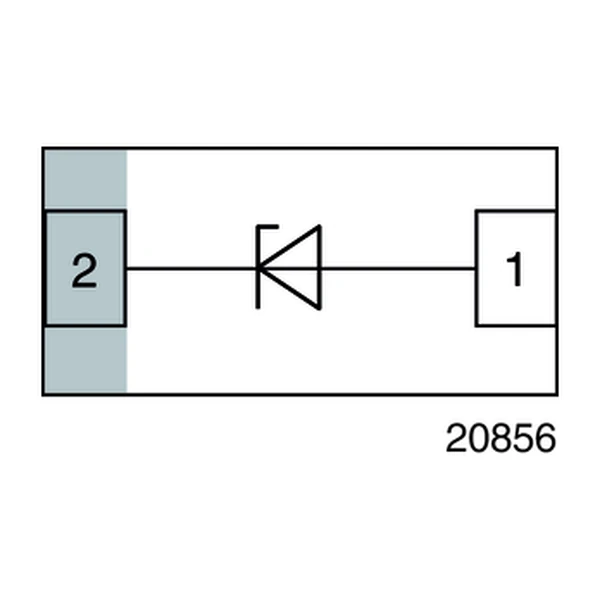
| Polarity | Unidirectional |
| Peak pulse power, 10/1000 us | 6600 W |
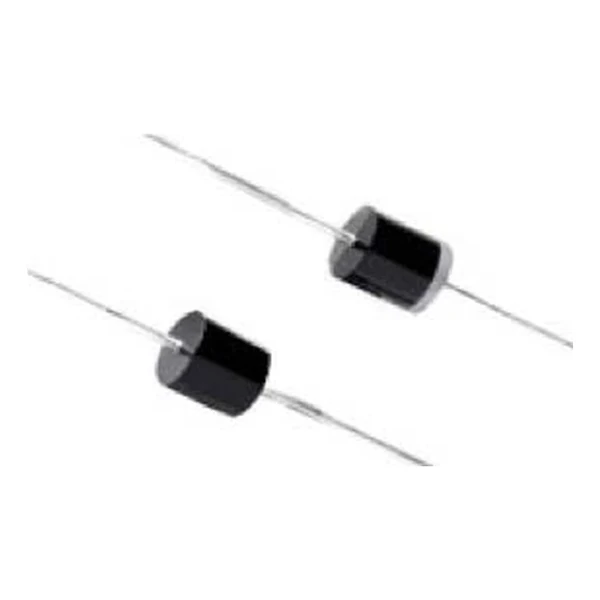
| Package | P600 axial |
| Mounting | Through-hole |
| Operating temperature | -55 °C to +175 °C |
| Qualification | AEC-Q200 |
| RoHS | Compliant, halogen free |
| Data sheet | Eaton Technical Data ELX1057 |
Outline drawing, pad or lead geometry and the pulse derating curves are
on the pages of Eaton Technical Data ELX1057; the package line above is the
body the part is built in.
What the Numbers Mean
The standoff voltage has to sit above the highest steady state level on the line, including regulation and ripple. The breakdown voltage is then one diode drop above that, and the clamp is what the downstream circuit actually sees.
The breakdown window spans 10.25 percent, from 24.4 V to 26.9 V. Design against the minimum, because a part at the bottom of the window starts conducting first.
At 22 V standing the leakage is at most 5 uA, so the part draws 0.11 mW on the rail. Small, but it is the number that matters on a battery input.
Within the 6KPE family this is item 5 of 13 in the Eaton catalogue.
Positioning in the Range
The part goes across the line after the fuse, with the return path as short as the layout allows. Every centimetre of trace between the connector and the diode adds inductance, and the clamp the circuit sees is the diode clamp plus L di/dt.
- A unidirectional part clamps a positive surge to its forward drop and a negative one to its breakdown. On an AC or bipolar signal that asymmetry is a design error, not a detail.
- The breakdown window is deliberately wide so that production spread does not leave parts conducting at the standoff voltage. Design to the minimum breakdown, not the typical.
Frequently Asked Questions
Why is the clamp voltage higher than the breakdown voltage?
The breakdown is measured at 1 mA; the clamp is measured at the full pulse current, which can be hundreds of amps. The dynamic resistance of the junction adds the difference, and that is why the two columns are never the same number.
Does the peak pulse power rating apply to any surge?
No. It is quoted for a 10/1000 microsecond waveform. A shorter pulse allows more current and a longer one less; the derating curve converts between them.
Unidirectional or bidirectional?
Unidirectional on a DC rail, where the forward direction gives a low clamp for one polarity. Bidirectional on AC, on differential pairs and wherever the surge can arrive with either polarity.
Shenzhen Gaorunxin Technology Co., Ltd
Online message
Shenzhen Gaorunxin Technology Co., Ltd