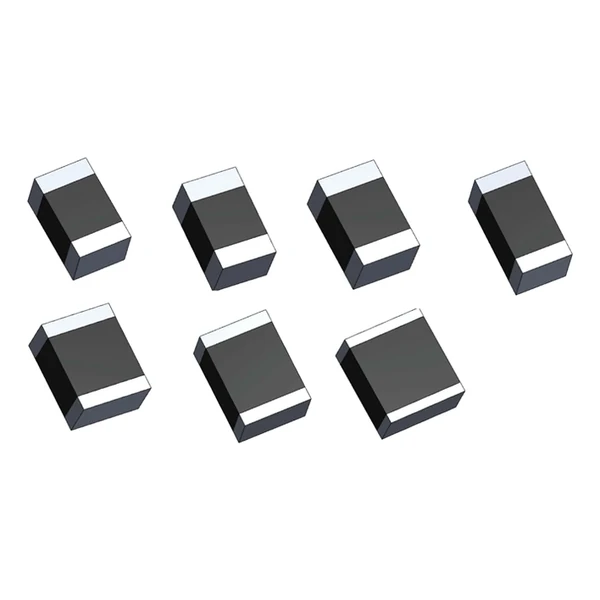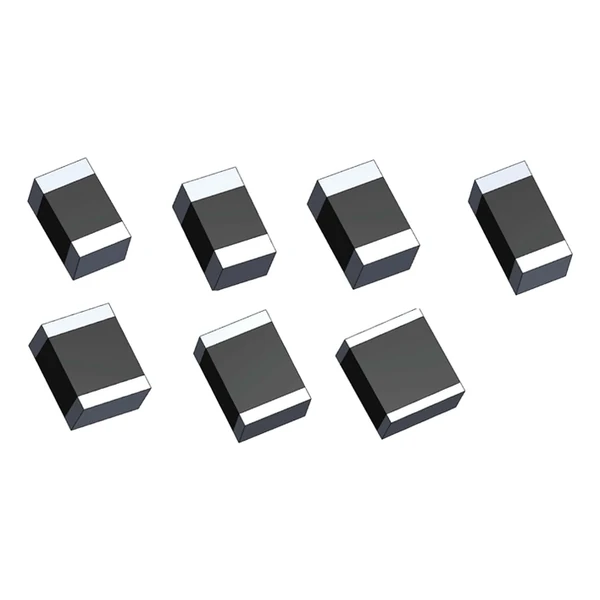
Eaton AMLV18V26C3200 Multilayer Varistor, 54 V Clamp
- Product Details
- Download
Eaton AMLV18V26C3200 Multilayer Varistor, 54 V Clamp
Ratings at a Glance
| Parameter | Value |
|---|---|
| Orderable part number | AMLV18V26C3200 |
| Working voltage, DC | 26 Vdc |
| Working voltage, AC | 20 Vac |
| Varistor voltage at 1 mA | 29.7 V to 36.3 V |
| Clamping voltage at 1 A | 54 V |
| Energy absorption, 10/1000 us | 3 J |
| Peak current, 8/20 us | 800 A |
| Typical capacitance at 1 MHz | 3200 pF |
| Vjump (5 min) | 30 V |
| WLD (10 pulses) | 6 J |
| Leakage current at working voltage | max. 20 uA |
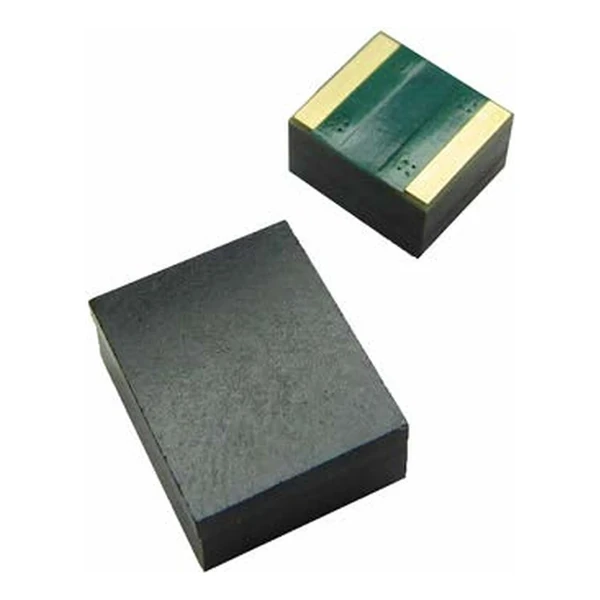
| Package | 1812 (4532 metric) |
| Mounting | Surface mount |
| Operating temperature | -55 °C to +125 °C |
| Qualification | AEC-Q200 |
| RoHS | Compliant, halogen free |
| Data sheet | Eaton Technical Data ELX1078 |
Dimensions, recommended pad or hole pattern and the derating curves are
on the data sheet pages; the package line above gives the body size as Eaton states it.
How to Read These Ratings
The working voltage is the DC or AC level the part can sit at continuously without conducting appreciably. Pick it above the highest steady-state rail voltage including tolerance, and let the clamp column decide whether the downstream part survives the surge.
The clamp column works out at 1.64 times the varistor voltage: 54 V at the rated current against 33 V at 1 mA. That ratio is what the downstream part has to survive, not the 33 V figure on the label.
Standing at 26 V the leakage is at most 20 uA, which is 0.52 mW of continuous dissipation. Small, but it is why a varistor on a battery rail has to be chosen on leakage and not only on voltage.
The 3200 pF typical capacitance is the cost of the clamp. On a power rail it is irrelevant; on a data line it is the reason to look at the low-capacitance versions of the same voltage.
Within the AMLV family this is item 24 of 28 in the Eaton catalogue.
Where This Series Fits
The return path is half the component. A varistor tied to a ground plane far from the connector leaves the loop inductance in series with the clamp, and the residual voltage at the chip is the clamp plus L di/dt.
- Do not run the part at its varistor voltage: the working voltage column is the continuous limit, and the varistor voltage is 1.5 to 2 times higher only because the ceramic is soft at the knee.
- These parts are halogen free and RoHS compliant without exemptions, which matters for automotive and appliance programmes.
Frequently Asked Questions
Does the clamp voltage scale with the surge current?
Yes. The clamp column is quoted at a stated current, usually 1 A. At ten times that current the residual voltage is higher, so read the V-I curve rather than the single number when the surge is large.
Why is the DC rating lower than the AC rating on some parts?
It is not, on these: the AC rating is an RMS value, so the DC rating is set at the peak of that sine plus margin. Where the two look inconsistent, check which one is quoted as RMS.
Can it protect a differential pair?
Only with a low-capacitance part and a layout that keeps both lines symmetric. A single varistor from each line to ground is normal; one across the pair is not, because it unbalances the pair.
Shenzhen Gaorunxin Technology Co., Ltd
Online message
Shenzhen Gaorunxin Technology Co., Ltd