Eaton DRAP124-821-R Automotive Shielded Inductor 0.7 A
- Product Details
- Download
Eaton DRAP124-821-R Automotive Shielded Inductor 0.7 A
Key Specifications
| Parameter | Value |
|---|---|
| Orderable part number | DRAP124-821-R |
| Rated inductance | 820 uH ±20% |
| Open circuit inductance (OCL) | 826 uH |
| Irms (40 °C rise) | 0.41 A |
| Isat1 (30% rolloff @ +25 °C) | 0.7 A |
| Isat2 (40% rolloff @ +125 °C) | 0.56 A |
| DCR typical @ 20 °C | 2570 mOhm |
| DCR maximum @ 20 °C | 3090 mOhm |
| K-factor (Bp-p = K x L x dI) | 4.5 |
| Package | 12.5 x 12.5 x 4.6 mm, four-terminal |
| Mounting | Surface mount |
| Operating temperature | -40 °C to +165 °C |
| Qualification | AEC-Q200 |
| RoHS | Compliant (-R suffix) |
How to Read These Ratings
Automotive magnetics are specified differently: the temperature range is wider, the qualification is AEC-Q200, and the construction has to hold together under vibration that would shake a commercial part off its pads. That is what the DRA series is.
Thermal margin in a module is not the same as thermal margin on a bench. The ratings assume a mounting condition; the enclosure, the potting and the neighbouring components change it.
Isat1 is the 30% rolloff point at +25 °C, Isat2 the 40% rolloff at +125 °C. In a buck converter the inductor current peaks at the top of the ripple, so the peak - not the average - is the number that has to stay below Isat with margin for the transient.
Where This Series Fits
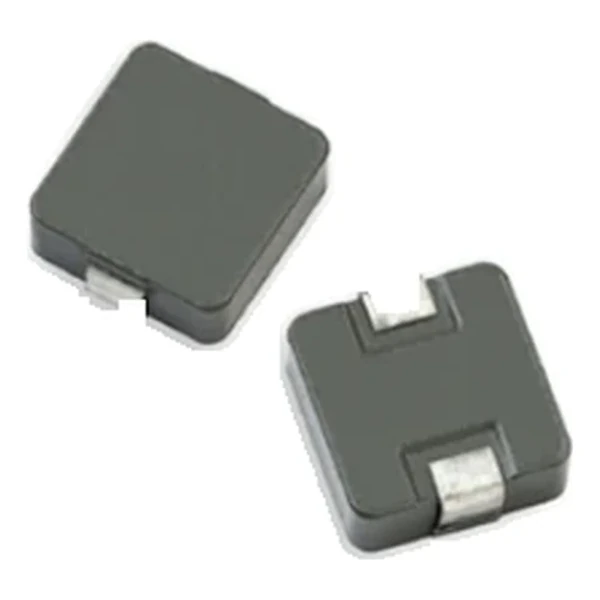
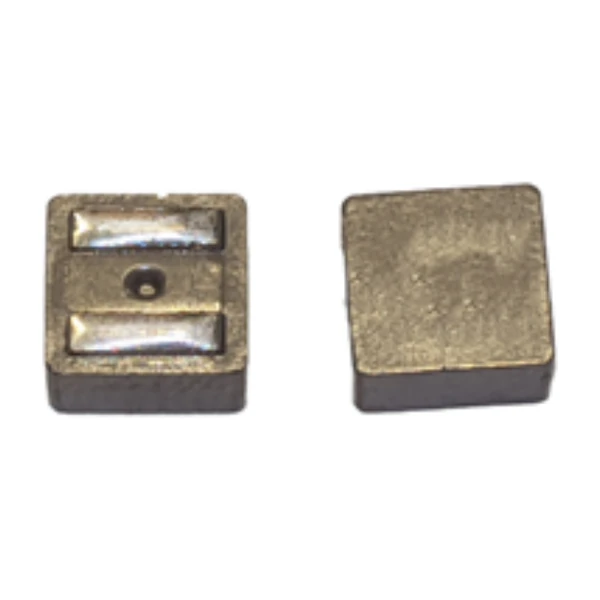
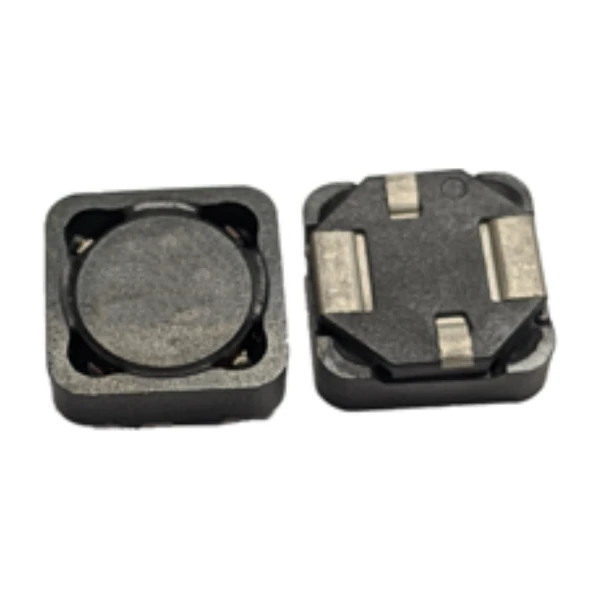
DRAP124 is the four-terminal version of the 12.5 mm automotive drum core. Two extra terminals clamp the body to the board, which is what makes it survive 30 g vibration - a two-terminal part of the same size does not.
- Typical applications: Automotive body electronics, LED lighting, ADAS, HVAC, infotainment, vibration-exposed modules.
- The fourth terminal is mechanical, not electrical - the pad layout has to account for it, and it is not a drop-in replacement for a two-terminal DR part.
- Data sheet 11040.
Sizing It Into a Design
820 uH sits at the high end of the range, and the trade at that point is explicit: 2570 mOhm of DCR against 0.7 A of saturation headroom.
Thermal design is not optional here. The rated current assumes a 40 °C rise with the part in free air on a stated pad; inside a closed box, on a thin board, next to a hot IC, that assumption is gone.
Frequently Asked Questions
Is the part shielded?
Yes, magnetically shielded, which is what keeps the field out of the radios, sensors and ADAS front ends that share the module.
Can I use it in a non-automotive design?
Yes, and people do when they need the vibration and temperature headroom. You pay for the qualification you may not need.
What does AEC-Q200 cover?
The qualification of the component itself: thermal shock, vibration, moisture, life and electrical stress. It does not qualify your assembly or your thermal design.
Design note: four terminals carry the vibration load - the mechanical joints need the same solder volume as the electrical ones, and the pad layout is not a two-terminal footprint.
Mechanical Dimensions

Dimensional drawing and recommended PCB pad layout from the Eaton data sheet. Tolerances and pad dimensions are as printed on the drawing; check the outline against your layout before release.
Shenzhen Gaorunxin Technology Co., Ltd
Online message
Shenzhen Gaorunxin Technology Co., Ltd