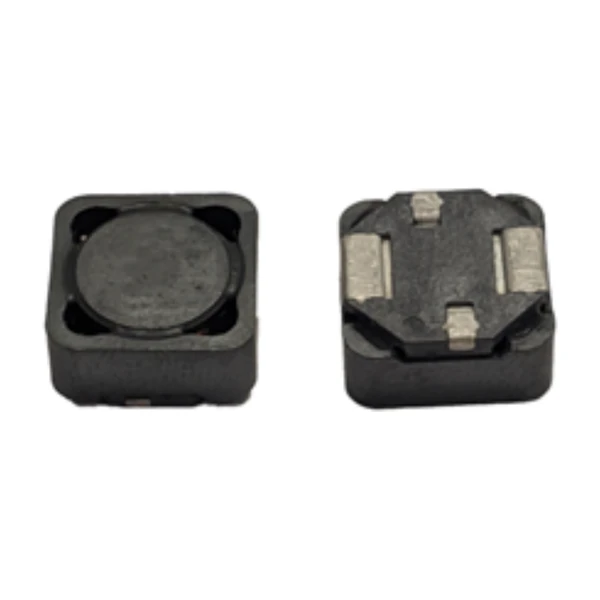
Eaton DRAP125-100-R Automotive Drum Core Inductor 10 uH
- Product Details
- Download
Eaton DRAP125-100-R Automotive Drum Core Inductor 10 uH
Electrical Specifications
| Parameter | Value |
|---|---|
| Orderable part number | DRAP125-100-R |
| Rated inductance | 10 uH ±20% |
| Open circuit inductance (OCL) | 9.22 uH |
| Irms (40 °C rise) | 5.57 A |
| Isat1 (30% rolloff @ +25 °C) | 7.22 A |
| Isat2 (40% rolloff @ +125 °C) | 5.77 A |
| DCR typical @ 20 °C | 17 mOhm |
| DCR maximum @ 20 °C | 21 mOhm |
| K-factor (Bp-p = K x L x dI) | 38.5 |
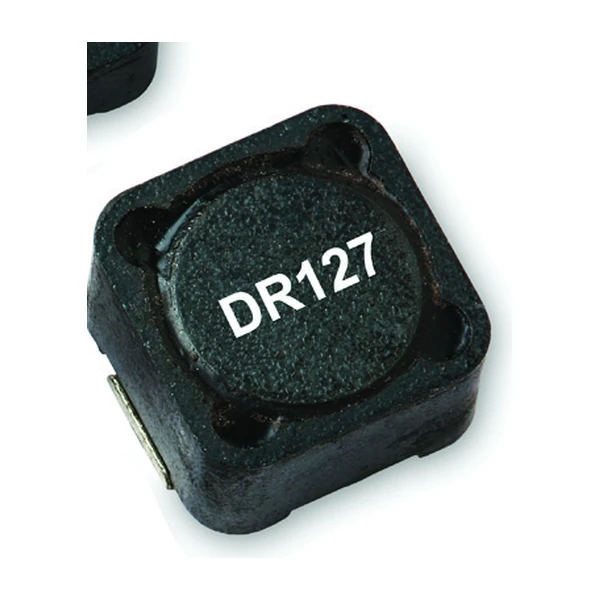
| Package | 12.5 x 12.5 x 6.1 mm, four-terminal |
| Mounting | Surface mount |
| Operating temperature | -40 °C to +165 °C |
| Qualification | AEC-Q200 |
| RoHS | Compliant (-R suffix) |
Reading the Data Sheet
Under-hood and in-module electronics see temperature cycling, vibration and long service life. The DRA/DRAP/DRAQ parts are built for that: AEC-Q200, wider temperature range, and mechanical features that keep the part attached.
Thermal margin in a module is not the same as thermal margin on a bench. The ratings assume a mounting condition; the enclosure, the potting and the neighbouring components change it.
The saturation current is measured at a defined roll-off, and Eaton states the percentage on the data sheet: Isat1 is the 30% rolloff point at +25 °C, Isat2 the 40% rolloff at +125 °C. Read the number with the percentage in hand, because "saturation" means different things at 25% and at 40%.
Positioning in the Range
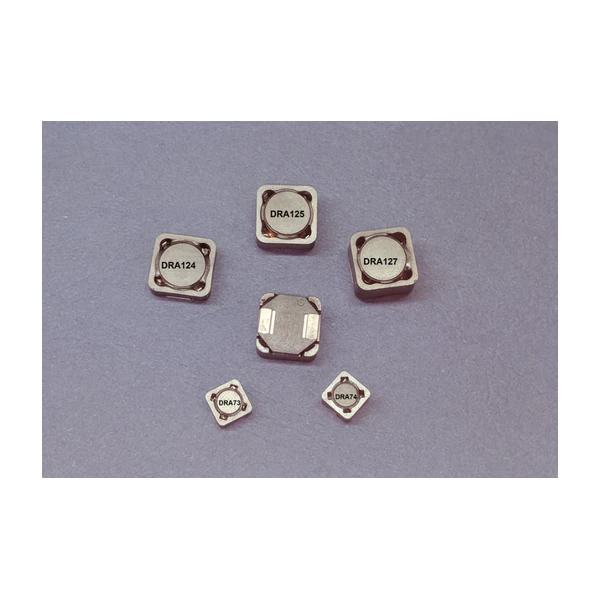
DRAP125 takes the four-terminal construction of DRAP124 and adds height for current. Same 12.5 x 12.5 footprint, 6.1 mm body, AEC-Q200 and 30 g vibration.
- Typical applications: Automotive DC-DC, body control, LED drivers, ADAS modules, seat and door controllers.
- Four-terminal mounting changes the reflow profile slightly - the mechanical joints need the same solder volume as the electrical ones.
- Data sheet 11041.
Sizing It Into a Design
Choose 10 uH when the ripple target is in the middle of the design window: the DCR stays at 17 mOhm and the saturation limit at 7.22 A leaves the transient room it needs.
Efficiency is set by where you sit on the loss curve, and the curve moves with switching frequency. A part that is excellent at 300 kHz can be mediocre at 1 MHz with the same current, because the core loss term takes over.
Frequently Asked Questions
Can I use it in a non-automotive design?
Yes, and people do when they need the vibration and temperature headroom. You pay for the qualification you may not need.
What is the operating temperature?
-40 °C to +165 °C, ambient plus self-temperature rise. That covers under-hood modules with margin for the rise.
Can I use it in a non-automotive design?
Yes, and people do when they need the vibration and temperature headroom. You pay for the qualification you may not need.
Design note: four terminals carry the vibration load - the mechanical joints need the same solder volume as the electrical ones, and the pad layout is not a two-terminal footprint.
Mechanical Dimensions

Dimensional drawing and recommended PCB pad layout from the Eaton data sheet. Tolerances and pad dimensions are as printed on the drawing; check the outline against your layout before release.
Shenzhen Gaorunxin Technology Co., Ltd
Online message
Shenzhen Gaorunxin Technology Co., Ltd