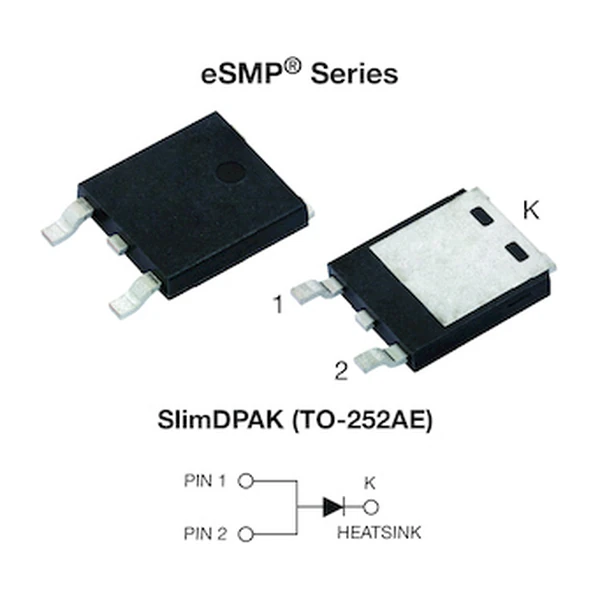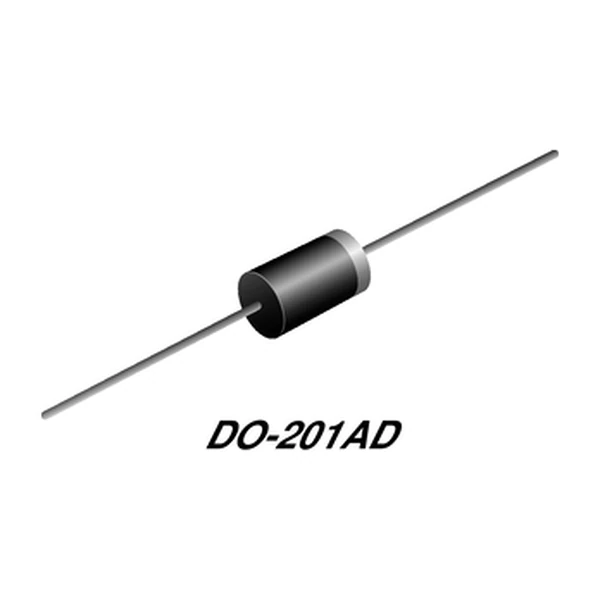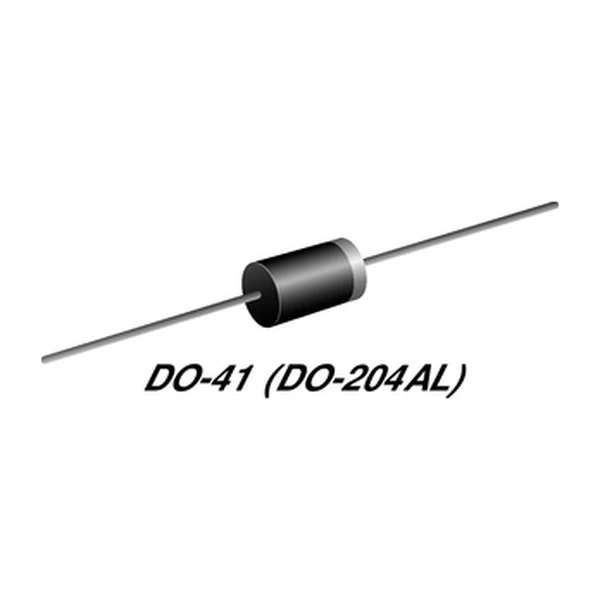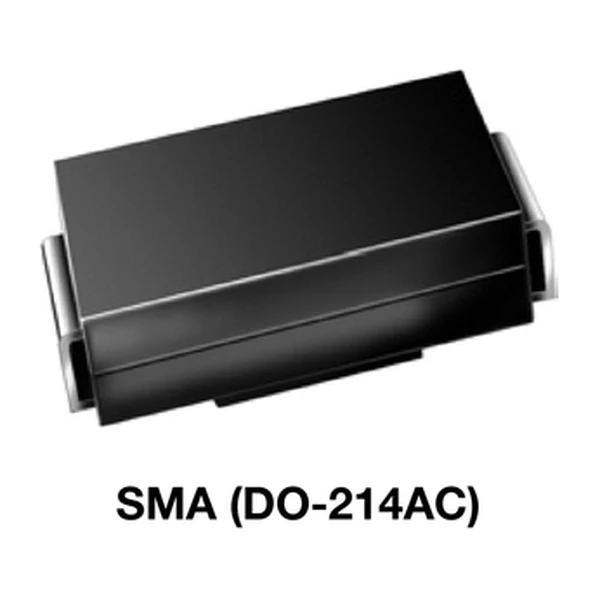
Eaton EREE1606BC 600 V 16 A Fast Recovery Diode
- Product Details
- Download
Eaton EREE1606BC 600 V 16 A Fast Recovery Diode
Specification Table
| Parameter | Value |
|---|---|
| Orderable part number | EREE1606BC |
| Repetitive peak reverse voltage (VRRM) | 600 V |
| Maximum RMS voltage (VRMS) | 420 V |
| Maximum DC blocking voltage (VDC) | 600 V |
| Average forward current (IF(AV)) | 16 A at TC = 100 °C |
| Peak forward surge current (IFSM) | 125 A, 8.3 ms half sine |
| Forward voltage (VF) | 1.7 V max, IF = 8 A Tj = 25 °C |
| Reverse current at VRRM, 25 °C | 5 uA max |
| Reverse recovery time (trr) | 35 ns max |
| Thermal resistance, junction to case | 1.8 °C/W |
| Operating junction and storage temperature | -55 °C to +150 °C |
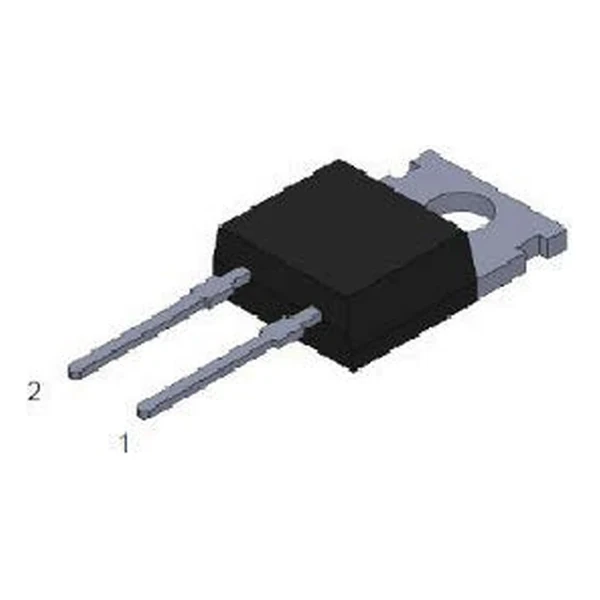
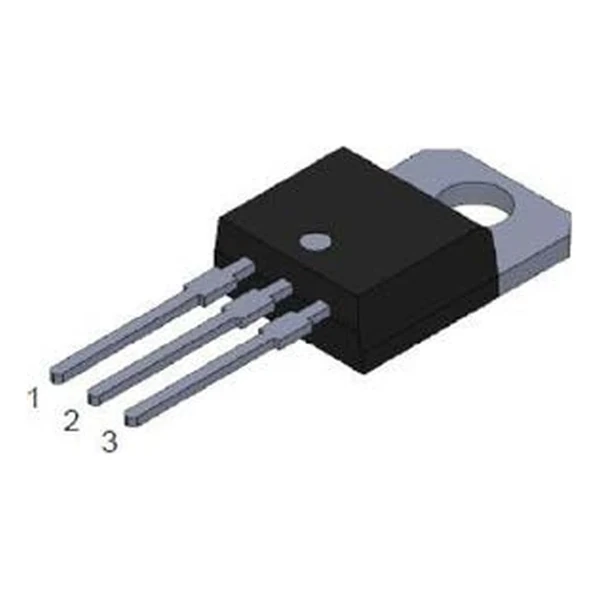
| Package | TO-220B-3L |
| Mounting | Through-hole |
| Weight | 1.94 g typical |
| Polarity | Cathode marked on the tab |
| Recovery class | Superfast |
| RoHS | Compliant, halogen free |
| Data sheet | Eaton Technical Data ELX1456 |
Rating conditions (ambient or case temperature, test current, dI/dt) are
as printed in Eaton Technical Data ELX1456; the values above are taken from the
table for this part number, not from a family summary.
How to Read These Ratings
Forward voltage and recovery time trade against each other in the design of the die. The family is offered in two recovery classes for that reason: the softer, faster part costs a little forward drop, and the lower drop part gives some of the speed back.
16 A through a 1.7 V drop is 27.2 W of conduction loss, and that is the figure the thermal path has to carry. The switch in the same loop dissipates on its own, so the diode is rarely the only heat source on the tab.
Against 1.8 °C/W the same 27.2 W lifts the junction by about 49 °C above the reference point of that figure. With 150 °C allowed, that leaves the margin the ambient or the heatsink has to stay inside.
The 600 V repetitive rating comes with a 420 V RMS figure, which is the 0.707 factor of the same sine. On a 230 V mains input the peak is already 325 V before any surge, so the margin here is what the transient clamp has to respect.
The surge rating is 8 times the average current, but only for one 8.3 ms half sine. Inrush that repeats on every power-up accumulates heat and has to be checked against the transient thermal impedance curve instead.
Hyperfast and superfast are relative terms. The die is a P-I-N structure with a thin drift region and lifetime control, so the stored charge that has to be swept out at turn-off is small. That is what makes the recovery time a few tens of nanoseconds instead of a few microseconds.
Board Layout
Place the snubber or the clamp across the diode only after the loop has been made as short as it can be. A snubber that compensates for a bad layout burns power every cycle to fix what copper would have fixed for free.
- The reverse voltage rating is a peak repetitive figure at the specified temperature. A mains-fed bridge on 230 V RMS sees 325 V peaks plus the surge margin, so a 400 V part is the minimum and 600 V is the usual choice.
- Reverse recovery charge is the integral of the recovery current. It is the figure that turns into switching loss in the counterpart switch, and it scales with forward current, not with voltage.
Frequently Asked Questions
What package should a 600 V, 10 A design use?
The choice is thermal, not electrical. A TO-252 carries the current but needs the copper to do it; a TO-220 or TO-247 gives a metal tab and a real thermal path. The same die in the two packages has very different usable current.
Is the surge rating a repetitive rating?
It is a single non-repetitive half sinewave at the stated duration. Repeated inrush, such as a capacitive load charging on every power-up, accumulates heat and has to be checked against the transient thermal impedance curve.
What does soft recovery actually mean?
The reverse current decays without an abrupt snap. That reduces the ringing between the diode capacitance and the loop inductance, which is what produces the voltage spike across the switch. Two parts with the same trr can behave very differently here.
Shenzhen Gaorunxin Technology Co., Ltd
Online message
Shenzhen Gaorunxin Technology Co., Ltd