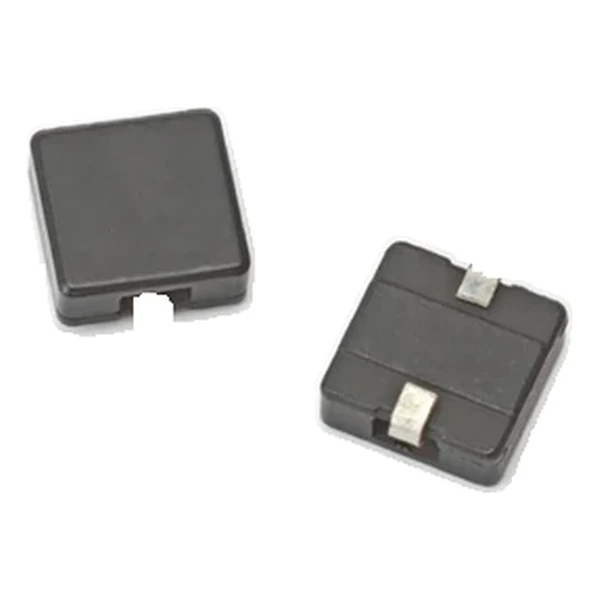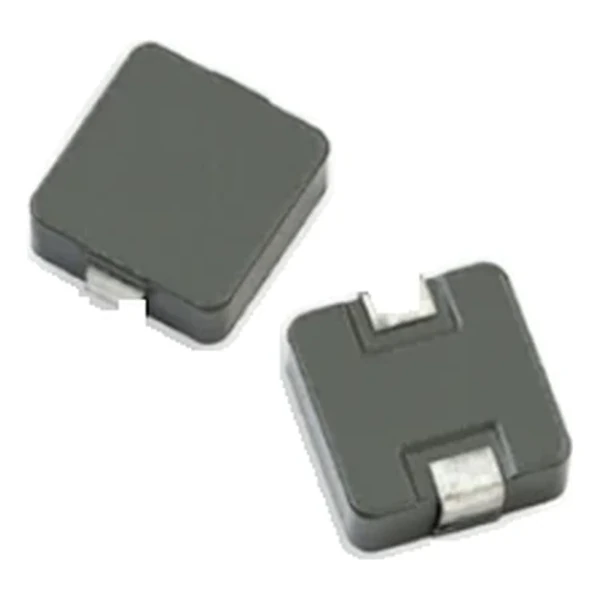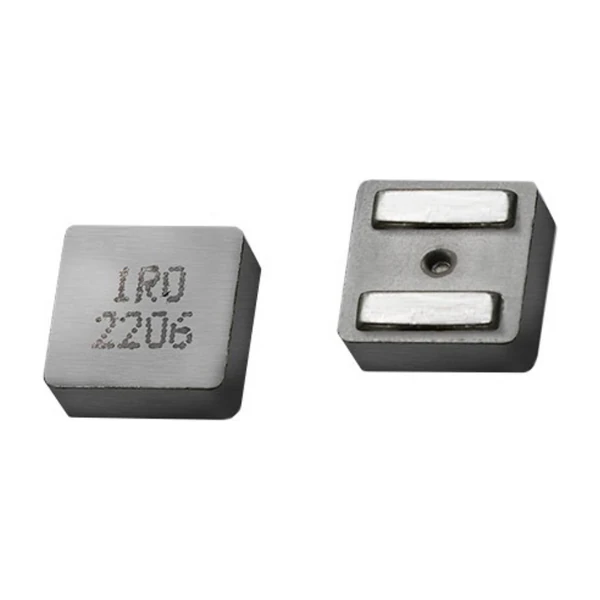


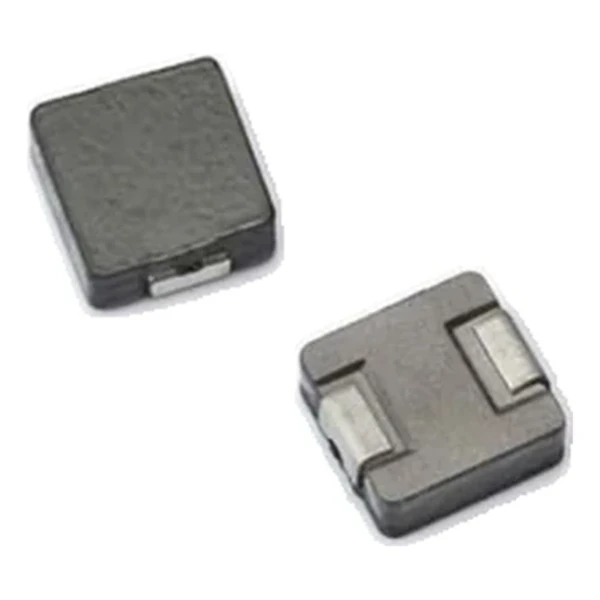
Eaton HCM0703-6R8-R Molded Inductor 6.8 uH, Isat 8 A
- Product Details
- Download
Eaton HCM0703-6R8-R Molded Inductor 6.8 uH, Isat 8 A
Specification Table
| Parameter | Value |
|---|---|
| Orderable part number | HCM0703-6R8-R |
| OCL (open circuit inductance) | 6.8 uH ±20% |
| FLL minimum, at Isat | 4.1 uH |
| Irms (DC, 40 °C rise) | 4.5 A |
| Isat (20% rolloff @ +25 °C) | 8 A |
| DCR typical @ +20 °C | 54 mOhm |
| DCR maximum @ +20 °C | 60 mOhm |
| K-factor (Bp-p = K x L x dI) | 151, Bp-p in Gauss |
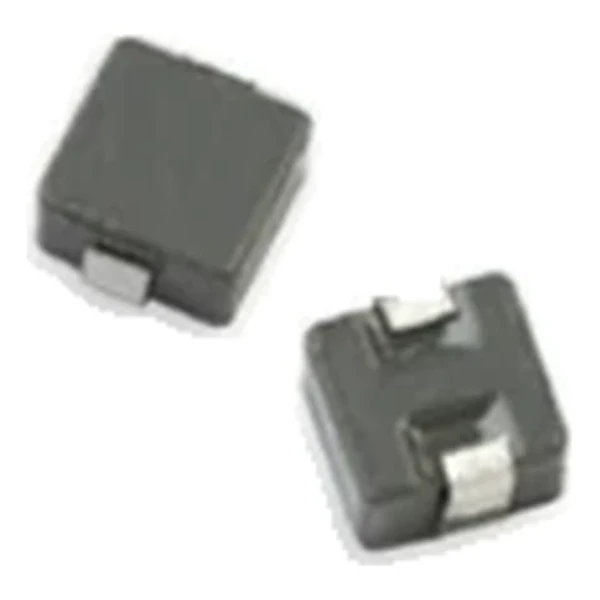
| Package | 7.4 x 6.8 mm |
| Height | 3.0 mm |
| Mounting | Surface mount |
| Operating temperature | -55 °C to +125 °C (ambient plus self-heating) |
| Qualification | Commercial grade |
| RoHS | Compliant, -R suffix |
| Data sheet | Eaton Technical Data 4085 |
Outline Drawing

Drawing reproduced from Eaton Technical Data 4085: outline with
rated mm dimensions, recommended pad layout and winding schematic. Tolerances are stated on
the drawing itself.
What the Numbers Mean
Molded construction is what gives this family its mechanical robustness and its shielding. Because the core surrounds the winding on all sides, the leakage field that would otherwise couple into adjacent traces is small, and the part can be placed close to sensitive nodes.
The DCR figure of 54 mOhm is what sets the efficiency: at 4.5 A the winding drops about 0.243 mV and dissipates 1.09 W. On a low-voltage rail that drop is a measurable fraction of the output, so the DCR column deserves as much attention as the inductance.
The Isat column is 20% rolloff @ +25 °C. Note what it does and does not mean: it is a defined rolloff point, not a destruction limit. Above it the inductance continues to fall, which is why the transient peak current should be checked against the curve, not just against the number.
Energy storage at the saturation current is around 218 uJ, the number that connects the inductance and the current rating into a single transient figure.
The K-factor of 151 converts inductance and ripple into flux swing: each amp of peak-to-peak ripple moves the core through about 1,027 Gauss of Bp-p, the figure the core-loss curve is plotted against.
Positioning in the Range
The HCM family is the commercial molded range: shielded powder-core parts from a 5.5 mm footprint up to a 17.5 mm body, covering 0.1 uH to tens of microhenry at currents from a few amps to over a hundred.
Within the HCM0703 family this is value 11 of 16, in a range that runs from 0.15 uH to 33 uH.
The next value up in the same family, HCM0703-8R2-R, gives 8.2 uH at 4 A and DCR 64 mOhm: the extra inductance costs about 1.5 A of rated current.
- Core material: iron powder core, 7.4 x 6.8 mm body at 3.0 mm.
- Typical applications: voltage regulator module (vrm); multi-phase regulators; point-of-loadmodules; desktop and server vrms and evrds; base station equipment; laptop and notebook regulators.
- The DCR columns are typical and maximum at +20 °C. Copper rises about 0.4 % per °C, so the hot resistance is higher than either column suggests.
Putting It to Work
Copper resistance rises with temperature, so at the +125 °C limit the maximum DCR of 60 mOhm becomes roughly 84.8 mOhm. That is the figure to put into a hot-enclosure loss calculation; the +20 °C column is a bench number.
Design note: two DCR columns let the loss budget be built either on the typical part or on the worst-case part. Use maximum for a guaranteed thermal design, typical for a nominal one.
- Check the hot DCR before signing off the efficiency budget.
- Check the hot DCR before signing off the efficiency budget.
- Check the hot DCR before signing off the efficiency budget.
Frequently Asked Questions
How much inductance is left at rated current?
That is what the saturation column describes. Isat is the peak current at which inductance has fallen by the stated percentage, so at the rated DC current the part is still inside that boundary.
How much inductance is left at rated current?
That is what the saturation column describes. Isat is the peak current at which inductance has fallen by the stated percentage, so at the rated DC current the part is still inside that boundary.
Is it magnetically shielded?
Yes. The powder core surrounds the winding, so the leakage field is small and the part can sit close to sensitive traces without a shield can.
Shenzhen Gaorunxin Technology Co., Ltd
Online message
Shenzhen Gaorunxin Technology Co., Ltd