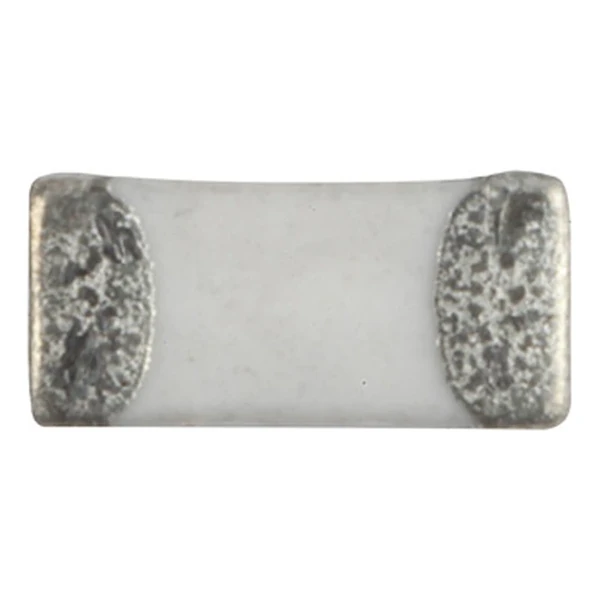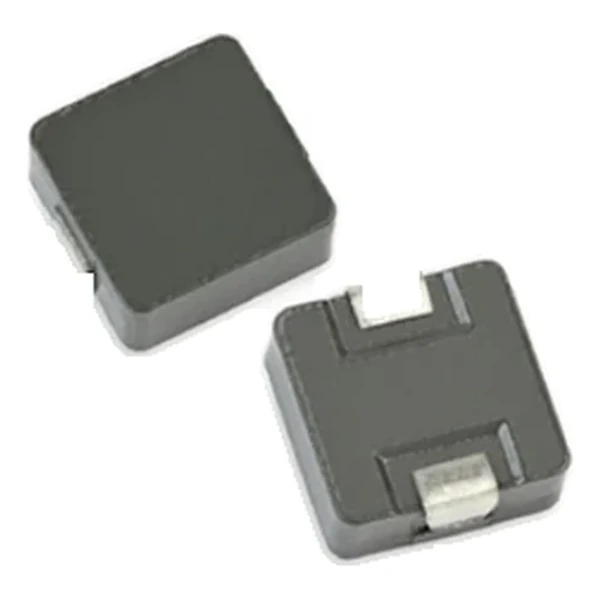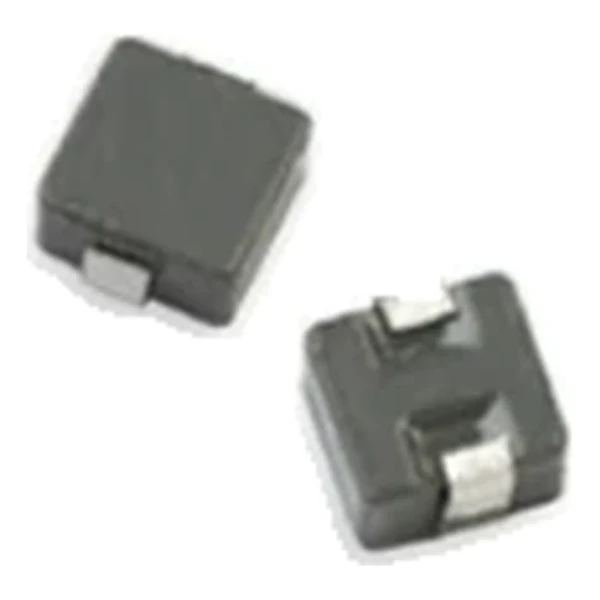


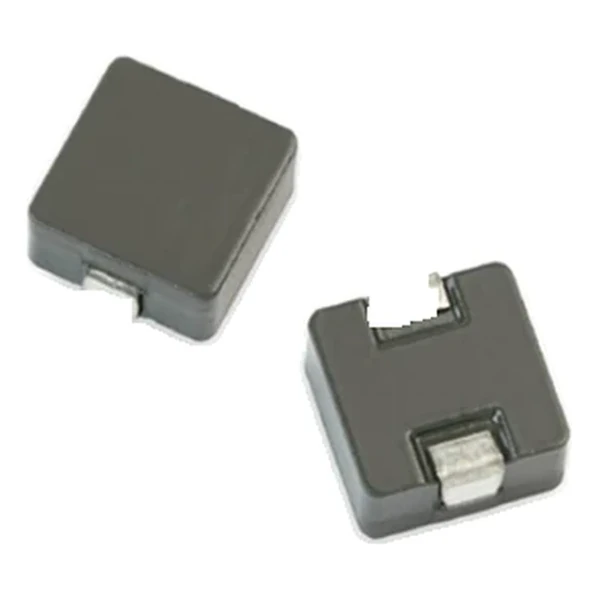
Eaton HCM1A1307V3-120-R 12 uH Shielded Automotive Inductor
- Product Details
- Download
Eaton HCM1A1307V3-120-R 12 uH Shielded Automotive Inductor
Electrical Specifications
| Parameter | Value |
|---|---|
| Orderable part number | HCM1A1307V3-120-R |
| OCL (open circuit inductance) | 12 uH ±20% |
| FLL minimum, at Isat | 7.68 uH |
| Irms (DC, 40 °C rise) | 8 A |
| Isat (20% rolloff @ +25 °C) | 12.5 A |
| DCR typical @ +20 °C | 16.4 mOhm |
| DCR maximum @ +20 °C | 18.9 mOhm |
| SRF typical | 8.5 MHz |
| K-factor (Bp-p = K x L x dI) | 109, Bp-p in Gauss |
| Package | 13.8 x 12.9 mm |
| Height | 6.5 mm |
| Mounting | Surface mount |
| Operating temperature | -55 °C to +155 °C (ambient plus self-heating) |
| Qualification | AEC-Q200 |
| RoHS | Compliant, -R suffix |
| Data sheet | Eaton Technical Data ELX1489 |
Mechanical Dimensions & Pad Layout

Drawing reproduced from Eaton Technical Data ELX1489: outline with
rated mm dimensions, recommended pad layout and winding schematic. Tolerances are stated on
the drawing itself.
Reading the Data Sheet
Automotive power rails ask for two things a commercial inductor does not always give: a qualified construction and a saturation curve that is still usable at the hot corner. The molded powder core here provides both, with AEC-Q200 qualification and a soft rolloff that keeps inductance present at transient peak current.
At the rated 8 A the winding dissipates about 1.05 W in copper alone, using the typical DCR of 16.4 mOhm. That figure is the floor of the loss budget: it assumes the current is pure DC, and any ripple adds to it.
Isat is specified as 20% rolloff @ +25 °C, so the number is a rolloff criterion rather than an absolute maximum. The useful working range extends a little beyond it on a soft saturation core, but the loop compensation has to be designed for the inductance that remains.
Stored energy at Isat is about 938 uJ, which is the energy the inductor hands to the load during a transient before the control loop reacts.
The K-factor of 109 converts inductance and ripple into flux swing: each amp of peak-to-peak ripple moves the core through about 1,308 Gauss of Bp-p, the figure the core-loss curve is plotted against.
Self-resonant frequency is 8.5 MHz typical. Above that the part becomes capacitive and stops behaving as an inductor, which is why the switching frequency and its first harmonics should stay well below it.
Where This Series Fits
The HCM1A family is the automotive molded range: AEC-Q200 qualified, rated to +155 °C, from a 5 mm footprint up to a 22 mm body. Several sizes carry a V2 or V3 revision with a higher current rating or an extra saturation column, so the revision letter is part of the specification.
Of the 20 values listed for HCM1A1307V3, this is the 16th, in a family covering 0.22 uH to 56 uH.
One step down the table, HCM1A1307V3-100-R, sits at 10 uH with 8.3 A and 15 mOhm – the lower inductance buys about 1.3 A of extra current in the same body.
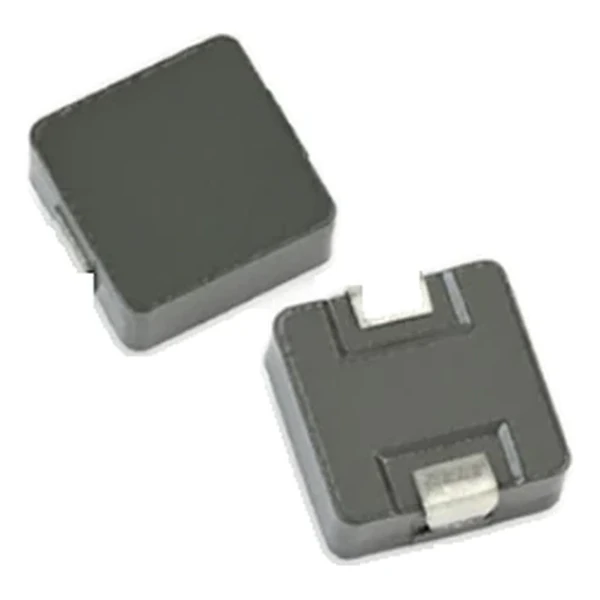
- Core material: alloy powder core, 13.8 x 12.9 mm body at 6.5 mm.
- Typical applications: body electronics; central body control module; headlamps, tail lamps and interior lighting and led lighting; heating ventilation and air conditioning controllers (hvac); doors, window lift and seat control; advanced driver assistance systems.
- The +155 °C rating is ambient plus self-temperature rise. Derate against the hot DCR, not the +20 °C value, when the board sits in a warm enclosure.
Design Notes
Copper resistance rises with temperature, so at the +155 °C limit the maximum DCR of 18.9 mOhm becomes roughly 28.9 mOhm. That is the figure to put into a hot-enclosure loss calculation; the +20 °C column is a bench number.
Design note: the revision letter changes the electrical row. V2 and V3 parts of the same body size are not drop-in substitutes for the base part; compare the tables row by row.
- Check the hot-corner saturation margin against the worst-case load step.
- Verify the part marking for revision traceability in production.
- Verify the part marking for revision traceability in production.
Frequently Asked Questions
What is the operating temperature range?
The rated range is quoted as ambient plus self-temperature rise, up to the maximum shown in the table. The part is qualified across that span, but the hot corner is where saturation and DCR must be checked.
Does the automotive grade change the electrical values?
Not by itself, but it changes the qualification and often the temperature range. Compare the rows of the automotive data sheet against the commercial one rather than assuming they match.
What does AEC-Q200 cover?
The qualification regime for passive components in automotive use: thermal shock, temperature cycling, vibration, mechanical shock, moisture resistance and solderability, among others. It qualifies the construction, not the board design.
Shenzhen Gaorunxin Technology Co., Ltd
Online message
Shenzhen Gaorunxin Technology Co., Ltd