Welcome to our company!



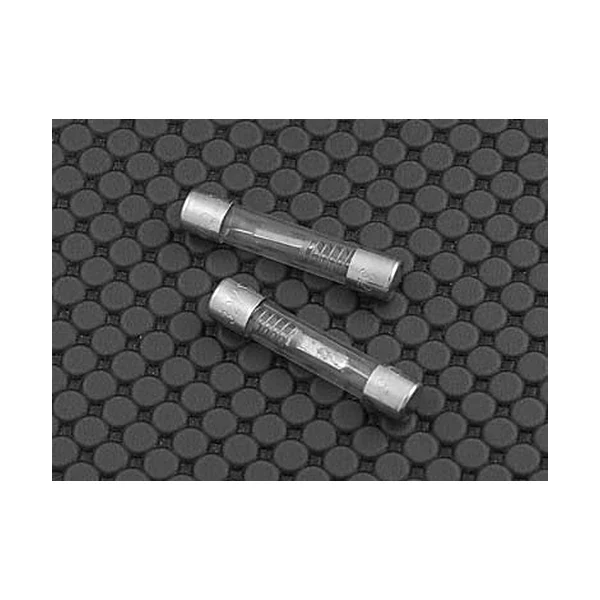
Eaton MDQ-1/2 500 mA Glass Fuse 250 Vac, Dual-Element Delay
Share
pEaton MDQ-1/2 — 500 mA, 250 V, time-delay glass cartridge fuse, 35 A at 250 Vac interrupting./p
- Product Details
- Download
Eaton MDQ-1/2 500 mA Glass Fuse 250 Vac, Dual-Element Delay
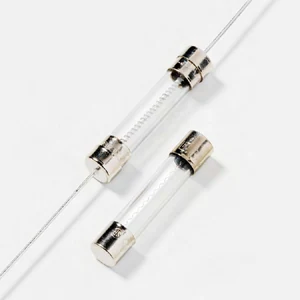
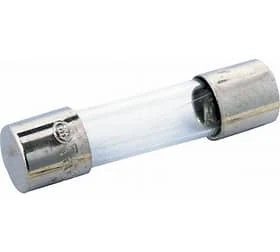
The MDQ-1/2 from Eaton carries 500 mA, rated 250 Vac, uses a time-delay element, in a glass body.
Technical Data
| Parameter | Rating |
|---|---|
| Part number | MDQ-1/2 |
| Element | dual element |
| Typical DC cold resistance | 1.4 Ω |
| Design standard | UL 248-14 |
| End caps | nickel-plated brass |
| AC interrupting rating | 35 A at 250 Vac |
| Voltage rating | 250 Vac |
| Body | Glass tube, 1/4 x 1-1/4 in (6.3 x 32 mm) |
| Rated current | 500 mA (1/2 A) |
| Breaking capacity | 35 A at 250 Vac up to 1 A, 100 A to 7 A, 1,000 A at 32 V above |
Practical Notes
- Interrupting capability is 35 A at 250 Vac — confirm the circuit's prospective fault current stays below this.
- Time-delay element rides through motor starting and capacitive inrush without nuisance opening.
- Startup surges of several times rated current are tolerated for a short window.
- Glass body lets you inspect the element after a fault.
- Best kept for lower fault-current circuits where visual diagnosis matters.
- Working voltage must stay at or below 250 Vac; a lower-rated part is not a safe substitute.
- Do not upsize beyond 500 mA to stop nuisance trips — fix the cause instead.
Application Scenarios
Common installation contexts include:
- EV
- surge
Questions and Answers
What are the ratings of the MDQ-1/2?
500 mA continuous at 250 Vac, interrupting rating 35 A at 250 Vac.
Is the MDQ-1/2 fast-acting or time-delay?
It is time-delay. It tolerates short inrush surges.
Can the MDQ-1/2 be used on a higher fault-current circuit?
No — its interrupting rating is 35 A at 250 Vac. Choose a part whose breaking capacity exceeds the prospective fault current.
Shenzhen Gaorunxin Technology Co., Ltd
Online message
Shenzhen Gaorunxin Technology Co., Ltd