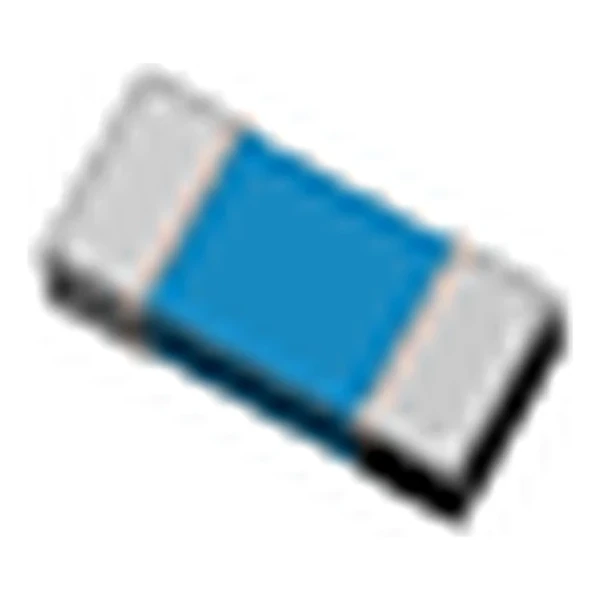
Eaton MLVC12V048C240 Multilayer Varistor, 110 V Clamp
- Product Details
- Download
Eaton MLVC12V048C240 Multilayer Varistor, 110 V Clamp
Specification Table
| Parameter | Value |
|---|---|
| Orderable part number | MLVC12V048C240 |
| Working voltage, DC | 48 Vdc |
| Working voltage, AC | 34 Vac |
| Varistor voltage at 1 mA | 62 V ±10% |
| Clamping voltage at 1 A | 110 V |
| Energy absorption, 10/1000 us | 0.4 J |
| Peak current, 8/20 us | 120 A |
| Typical capacitance at 1 MHz | 240 pF |
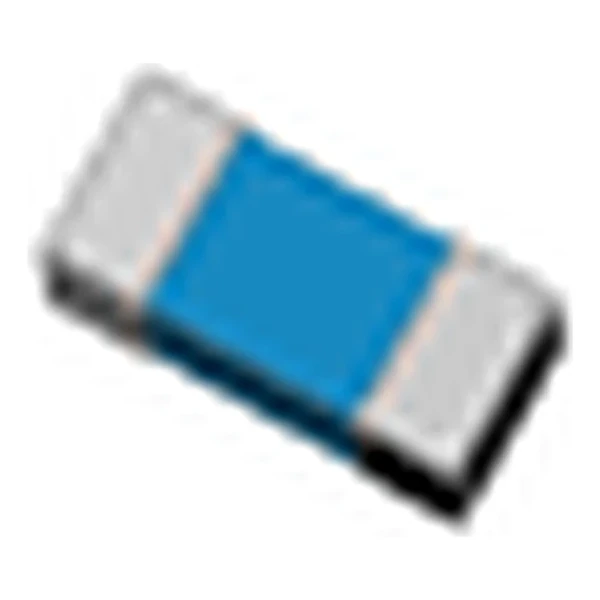
| Package | 1206 (3216 metric) |
| Mounting | Surface mount |
| Operating temperature | -55 °C to +125 °C |
| Qualification | Commercial grade |
| RoHS | Compliant, halogen free |
| Data sheet | Eaton Technical Data 11236 |
Dimensions, recommended pad or hole pattern and the derating curves are
on the data sheet pages; the package line above gives the body size as Eaton states it.
How to Read These Ratings
A chip varistor is a ceramic body with two metal terminations, so it looks like a capacitor and behaves like one until the transient arrives. That is why the capacitance column is quoted on every page: it is the parameter that decides whether the part can sit on a data line.
The clamp column works out at 1.77 times the varistor voltage: 110 V at the rated current against 62 V at 1 mA. That ratio is what the downstream part has to survive, not the 62 V figure on the label.
The 240 pF typical capacitance is the cost of the clamp. On a power rail it is irrelevant; on a data line it is the reason to look at the low-capacitance versions of the same voltage.
Within the MLVC high energy family this is item 21 of 97 in the Eaton catalogue.
Positioning in the Range
Place it on the connector side of any series impedance. A varistor behind a common-mode choke protects the choke and not the connector, which is usually the wrong way round.
- Do not use a varistor as a series element or in a signal path carrying DC. It is a shunt device, and any steady current through it is a fault.
- The response time is quoted below a nanosecond because the ceramic turns conductive in the grain boundaries, not because of a junction.
Frequently Asked Questions
What does the capacitance do to my signal?
It loads the line. At 1 MHz a 100 pF part is about 1.6 kOhm of reactance, which is harmless on a power rail and fatal on a 480 Mbit USB pair. Choose a low-capacitance version when the line carries data.
How many ESD strikes can it take?
The ESD rating is a qualification level, not a lifetime count. IEC 61000-4-2 level 4 is 8 kV contact and 15 kV air, and the part is expected to survive repeated strikes at that level because the energy per strike is small.
Does the clamp voltage scale with the surge current?
Yes. The clamp column is quoted at a stated current, usually 1 A. At ten times that current the residual voltage is higher, so read the V-I curve rather than the single number when the surge is large.
Shenzhen Gaorunxin Technology Co., Ltd
Online message
Shenzhen Gaorunxin Technology Co., Ltd