

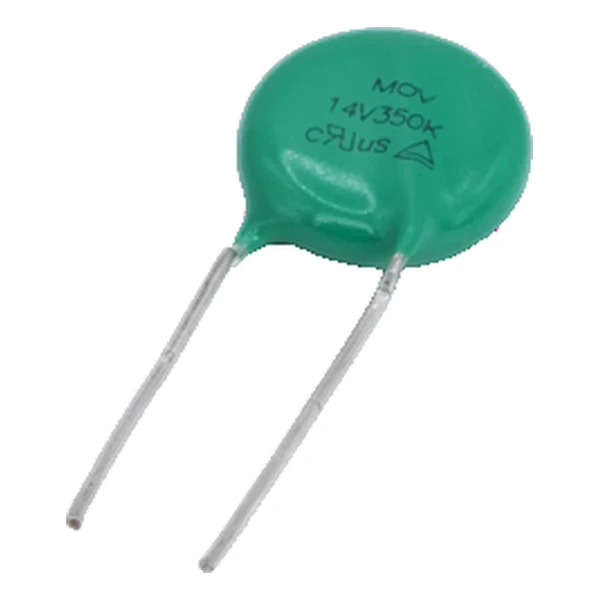
Eaton MOV14V320 320 Vac Radial Varistor
- Product Details
- Download
Eaton MOV14V320 320 Vac Radial Varistor
Specification Table
| Parameter | Value |
|---|---|
| Orderable part number | MOV14V320 |
| Varistor voltage at 1 mA | 510 V |
| Maximum continuous AC voltage | 320 Vrms |
| Maximum continuous DC voltage | 415 Vdc |
| Clamping voltage | 845 V |
| Clamping current | 50 A |
| Maximum surge current, 8/20 us | 4500 A |
| Rated power | 0.6 W |
| Typical capacitance at 1 kHz | 390 pF |
| Maximum energy, 10/1000 us | 121 J |
| Maximum body diameter | 6 mm |
| Agency recognition | cURus (UL 1449) and TUV |
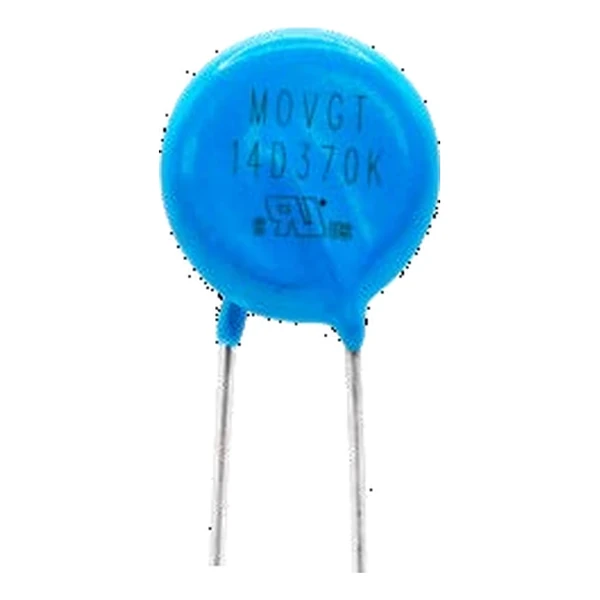
| Package | 14 mm disc |
| Mounting | Radial, through-hole |
| Operating temperature | -40 °C to +125 °C |
| Qualification | Commercial grade |
| RoHS | Compliant, halogen free |
| Data sheet | Eaton Technical Data ELX1287 |
Dimensions, recommended pad or hole pattern and the derating curves are
on the data sheet pages; the package line above gives the body size as Eaton states it.
How to Read These Ratings
This is a single-shot device in the sense that the joule rating is quoted for one pulse. A surge protector built around a disc survives because the pulses are rare, not because the part is unlimited; the derating curve states how many.
The clamp column works out at 1.66 times the varistor voltage: 845 V at the rated current against 510 V at 1 mA. That ratio is what the downstream part has to survive, not the 510 V figure on the label.
The disc absorbs 121 J in a 10/1000 us pulse and carries 4500 A in an 8/20 us pulse. Those are single shot figures: the same part will take a fraction of the energy repeatedly.
At 0.6 W continuous rating the body can sit at the working voltage indefinitely. A 20 mm disc handles roughly 390 pF across the line, which matters on a signal-carrying pair but not on a mains input.
Within the MOV family this is item 44 of 71 in the Eaton catalogue.
Positioning in the Range
Mount it with the body clear of the transformer and the bridge rectifier; a disc running at its rated power needs air, and the derating curve assumes it gets some.
- The clamping voltage is quoted at a test current that is far below the surge. At the full 8/20 rating the residual voltage is higher – read the V-I curve.
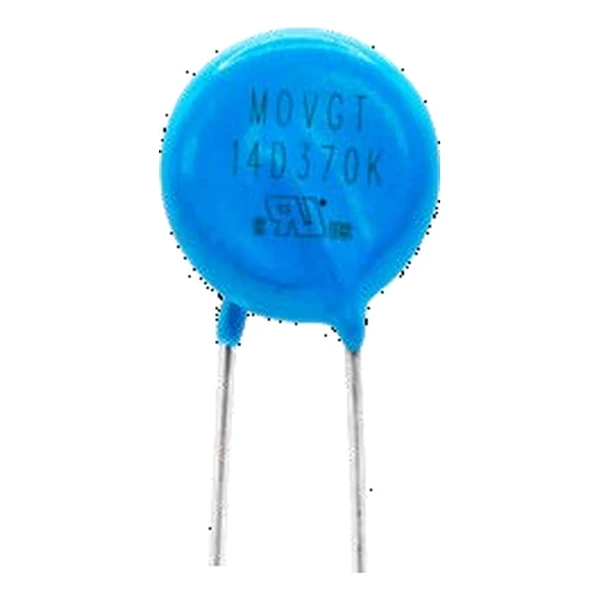
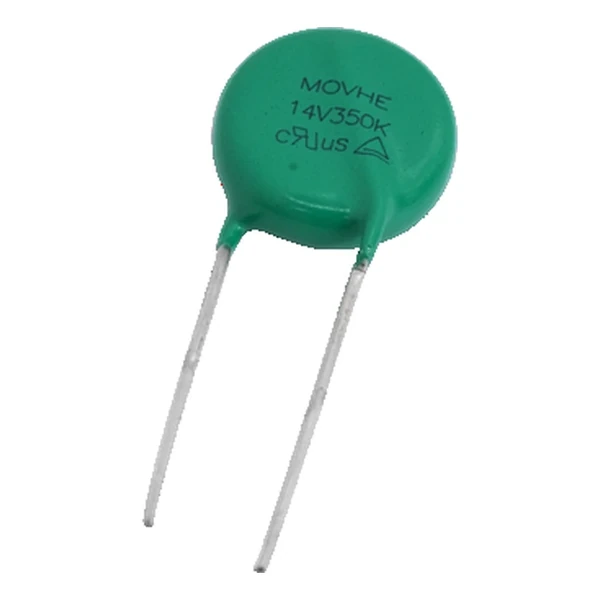
- The marking on the body gives the part number and the varistor voltage. In a service situation that marking is how the failed part gets identified.
Frequently Asked Questions
Can it be used on a DC bus?
Yes, within the DC rating, but the energy per event is usually larger because there is no zero crossing to help extinguish the follow current. Check the application note before using a mains part on a high-voltage DC bus.
How do I choose between 130 V and 150 V for a 120 V line?
On a 120 V nominal line the steady-state RMS can reach 132 V or more, so a 130 Vac part has no headroom. The 150 V part is the usual choice, and the varistor voltage that comes with it is still below the withstand of most downstream parts.
Does the lead spacing matter electrically?
It matters mechanically and for inductance. Wider spacing means a larger loop, which adds inductance in series with the clamp; the disc diameter sets the spacing, so the two choices are linked.
Shenzhen Gaorunxin Technology Co., Ltd
Online message
Shenzhen Gaorunxin Technology Co., Ltd