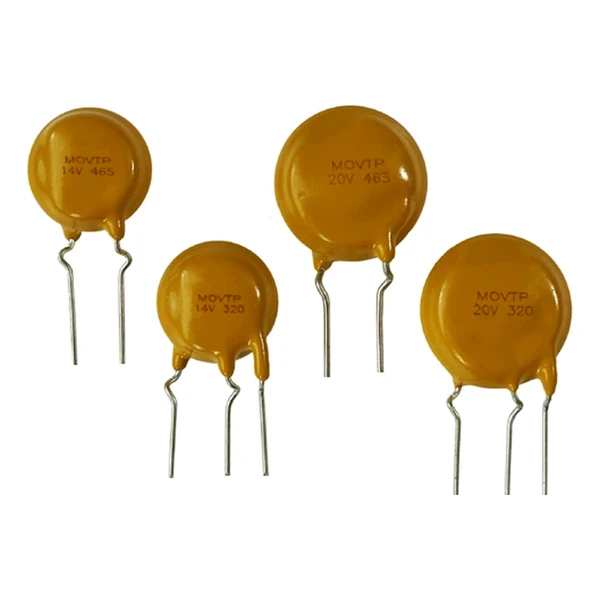
Eaton MOVTP20V320N Thermally Protected Varistor 320 Vac
- Product Details
- Download
Eaton MOVTP20V320N Thermally Protected Varistor 320 Vac
Ratings at a Glance
| Parameter | Value |
|---|---|
| Orderable part number | MOVTP20V320N |
| Working voltage, DC | 410 Vdc |
| Working voltage, AC | 320 Vac |
| Varistor voltage at 1 mA | 459 V to 561 V |
| Clamping voltage, 8/20 us | 845 V at 100 A |
| Energy absorption, 10/1000 us | 386 J |
| Rated power | 1 W |
| Peak current, 8/20 us | 10000 A |
| Impulse response time | under 25 ns |
| Leakage current at 0.75 V1mA | max. 20 uA |
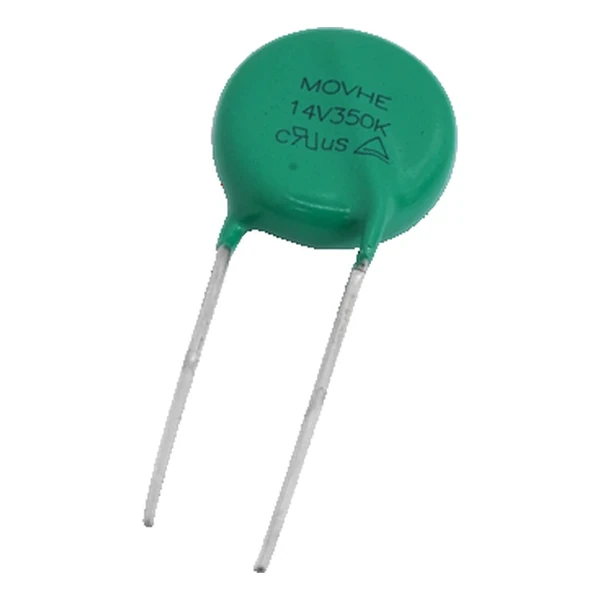
| Pin form | 2-lead, no status contact |
| Package | 20 mm disc |
| Mounting | Radial, through-hole |
| Operating temperature | -40 °C to +105 °C |
| Qualification | Commercial grade |
| RoHS | Compliant, halogen free |
| Data sheet | Eaton Technical Data ELX1079 |
Dimensions, recommended pad or hole pattern and the derating curves are
on the data sheet pages; the package line above gives the body size as Eaton states it.
How to Read These Ratings
The element is thermally coupled to the body, not to the current. That distinction matters: a slow overload that heats the disc without a large current still trips it, which a fuse in series would not see.
The clamp column works out at 1.66 times the varistor voltage: 845 V at the rated current against 510 V at 1 mA. That ratio is what the downstream part has to survive, not the 510 V figure on the label.
Standing at 410 V the leakage is at most 20 uA, which is 8.2 mW of continuous dissipation. Small, but it is why a varistor on a battery rail has to be chosen on leakage and not only on voltage.
The thermal element is the difference from a plain disc of the same rating. If the body overheats the element opens at 1 W of continuous overload, before the epoxy and the board around it are damaged.
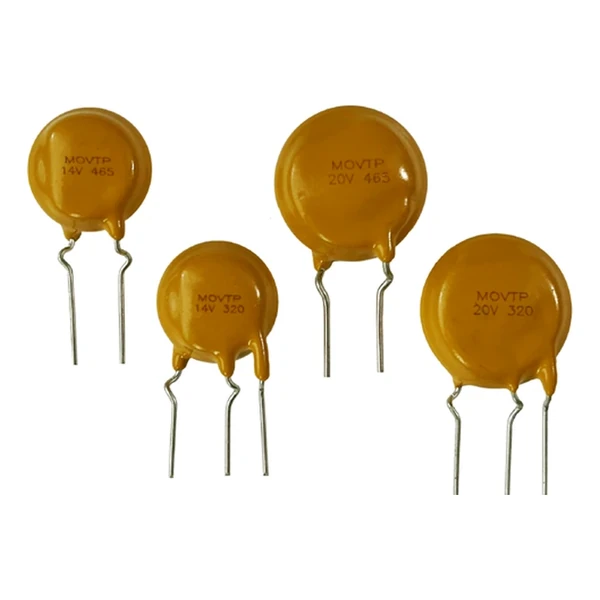
The 2-lead form is the mechanical difference: two leads replace a plain disc one for one. The electrical table is identical for both.
Within the MOVTP family this is item 25 of 28 in the Eaton catalogue.
Where This Series Fits
Leave the clearance the drawing asks for. The thermal element is inside the package, but the heat that trips it has to come from the body, and a part pressed against a heatsink or a capacitor sees the wrong temperature.
- The thermal element protects against a shorted varistor, not against overvoltage. It does not replace the fuse, and it does not reset: once it opens the part is finished.
- The two-lead and three-lead versions share the electrical table, so the ordering code suffix is the only difference between them.
Frequently Asked Questions
Should I use the two-lead or the three-lead version?
Two-lead where the part only has to protect. Three-lead where the status has to be reported: the third pin carries the thermal contact out so a monitoring circuit can see that the protector has operated.
Does it reset after operation?
No. The element is one-shot, like a fuse. Once it opens the board has to be repaired, which is the intended behaviour: the alternative is a shorted MOV heating the board.
Is the electrical rating different from an unprotected MOV?
No, the disc inside is the same. The thermal element adds series resistance of a few milliohms and takes space, but the voltage and energy ratings are unchanged.
Shenzhen Gaorunxin Technology Co., Ltd
Online message
Shenzhen Gaorunxin Technology Co., Ltd