

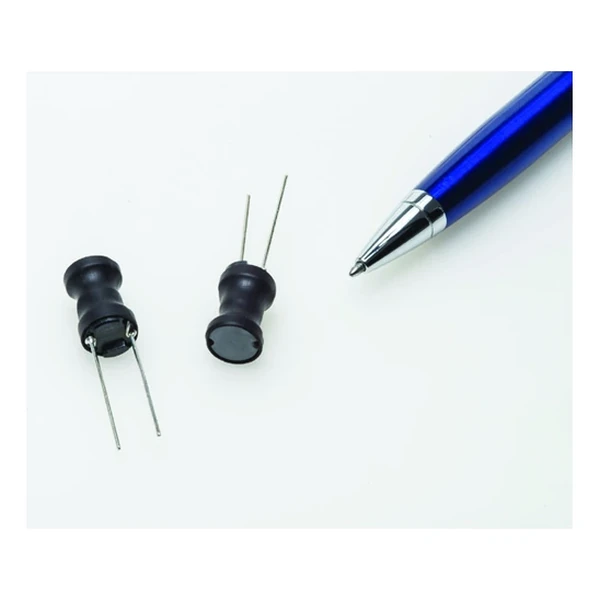
Eaton RL1218-682-R 6800 uH Unshielded Drum Core Inductor
- Product Details
- Download
Eaton RL1218-682-R 6800 uH Unshielded Drum Core Inductor
Key Specifications
| Parameter | Value |
|---|---|
| Orderable part number | RL1218-682-R |
| Inductance | 6800 uH |
| DCR typical @ +20 °C | 8200 mOhm |
| Irms (DC, 40 °C rise) | 0.263 A |
| Isat | 0.379 A |
| SRF typical | 0.36 MHz |
| Mounting | Through-hole |
| Operating temperature | -40 °C to +125 °C |
| Qualification | Commercial grade |
| RoHS | Compliant, -R suffix |
| Data sheet | Eaton Technical Data 10338 |
Mechanical Dimensions & Pad Layout

Drawing reproduced from Eaton Technical Data 10338: outline with
rated mm dimensions, pad layout and marking.
Reading the Data Sheet
This is a through-hole drum core choke: ferrite drum, wound coil, heat-shrink sleeve, tinned leads. The value range runs from a few microhenry into the millihenry region.
At 0.263 A the winding dissipates about 0.567 W in copper using the typical DCR of 8200 mOhm. That is the DC floor of the loss budget – ripple and core loss come on top.
The core stores about 488 uJ at the saturation point, which is the energy available to bridge a load step.
Self-resonance is 0.36 MHz typical. Keep the operating band, and the harmonics that carry energy, below it.
Within the RL1218 family this is value 18 of 19, in a range from 4.7 uH to 12000 uH.
Positioning in the Range
The RL family is the radial leaded drum core range: through-hole parts with a protective sleeve, covering microhenry to millihenry values.
- The leads and the plated holes are part of the current path. Check them, not just the winding, against the rated current.
- Typical applications: led drivers and lighting; utility meters; appliances and white goods; motor drives; power supplies.
- Design note: leave clearance around the part for the sleeve and for the field. The inductance depends on nearby metal.
Frequently Asked Questions
Why a sleeve over the winding?
It protects the coil during handling and gives the part a defined outside diameter for automated placement.
Can it be used in a switching supply?
Yes, at the switching frequencies its core loss allows. Compare the core loss curve before assuming the DC rating is the limit.
Why a sleeve over the winding?
It protects the coil during handling and gives the part a defined outside diameter for automated placement.
Shenzhen Gaorunxin Technology Co., Ltd
Online message
Shenzhen Gaorunxin Technology Co., Ltd