Welcome to our company!



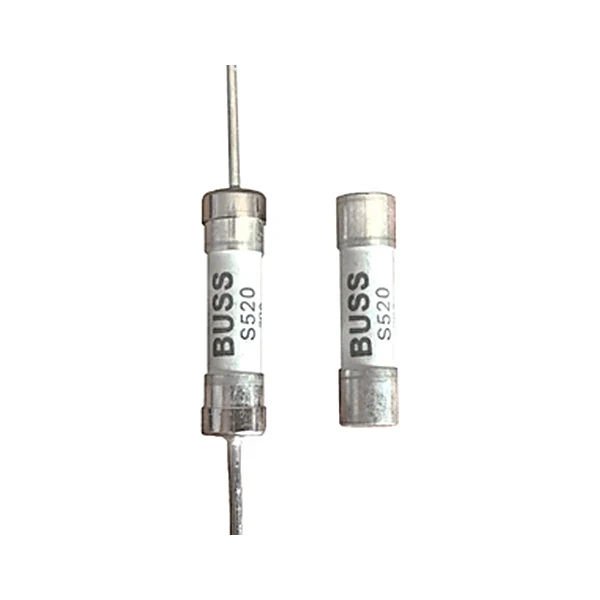
Eaton S520-V-16-R 16 A 420 Vac Fast-Acting Axial Lead Ceramic Tube Fuse
Share
pEaton S520-V-16-R — 16 A, 420 V, fast-acting ceramic cartridge fuse, 300 A interrupting./p
- Product Details
- Download
Eaton S520-V-16-R 16 A 420 Vac Fast-Acting Axial Lead Ceramic Tube Fuse
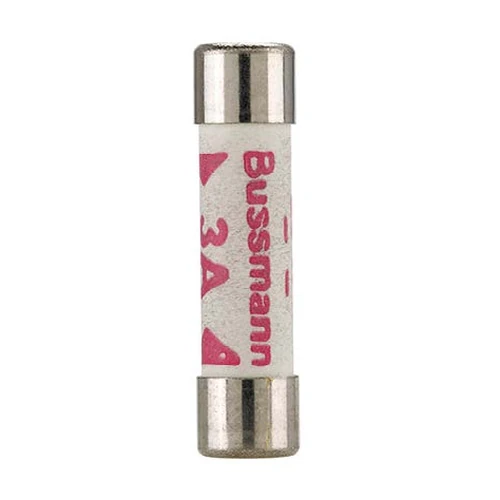
Built by Eaton, the S520-V-16-R carries 16 A, uses a fast-acting element, in a ceramic body.
Technical Data
| Parameter | Rating |
|---|---|
| Parameter | Value |
| Orderable part number | S520-V-16-R (TR2- = 1,500 pcs on reel) |
| Interrupting rating at 420 Vac | 300 A |
| Voltage drop (typical) | 200 mV at rated current |
| Current rating | 16 A A |
| Agency | UR E19180 (JDYX2); TUV T 50484820 02 |
| Melting I2t (typical) | 280 A2s at 10 In |
| Lead spacing (dim B) | 38.1 mm +/- 0.38 (BK-) / 15.8 mm +/- 2.0 (TR2-) |
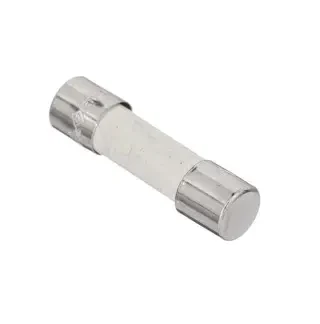
| Body | 5 x 20 mm ceramic tube, nickel/silver plated brass ends |
| Lead diameter (dim A) | 1.0 mm tinned copper |
| Interrupting rating at 250 Vac | 1500 A |
| Un (rated) | 420 Vac |
| Typical DC cold resistance | 6.1 mOhm |
Selection Notes
- Interrupting capability is 300 A — confirm the circuit's prospective fault current stays below this.
- Fast element suits resistive and semiconductor loads rather than motors with high inrush.
- Because it opens within milliseconds, downstream semiconductors see less let-through energy.
- Ceramic body holds higher breaking capacity than glass at the same footprint.
- It is the usual choice where prospective fault current is high.
- Do not upsize beyond 16 A to stop nuisance trips — fix the cause instead.
Typical Applications
Engineers usually specify it for these duties:
- EV
- transformer
Q&A
Is the S520-V-16-R fast-acting or time-delay?
It is fast-acting. Expect it to open quickly on overload.
Can the S520-V-16-R be used on a higher fault-current circuit?
No — its interrupting rating is 300 A. Choose a part whose breaking capacity exceeds the prospective fault current.
Shenzhen Gaorunxin Technology Co., Ltd
Online message
Shenzhen Gaorunxin Technology Co., Ltd